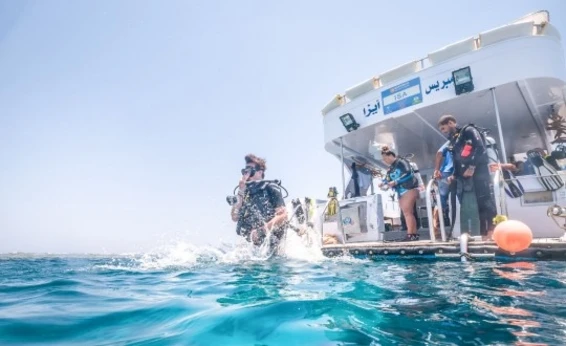
Red Sea South Diving: Encounters with Pelagic Sharks
...Highlights: hammerhead sharks, shark action, dolphins, manta rays, dugongs, schooling fish & big pelagics...
...Diving environment: healthy reefs, wreck diving, wall diving, drift diving, caverns, advanced divers, very popular...
Over recent years liveaboards to the Southern Red Sea have grown dramatically in popularity, to such an extent that new towns have sprang up down the Egyptian coastline to facilitate such activity. The popularity of such diving trips might even rival that of Northern Red Sea, and certainly most experienced scuba divers would now head straight for the south.
This change in appeal has taken place partly due to liveaboard divers' preference to avoid the hustle of busy day trip diving and resort towns such as Sharm El Sheikh and Hurghada. But also because experienced visitors have come to recognise the huge attractions that Egypt's Southern Red Sea reefs have, such as frequent encounters with pelagic sharks, large schools of fish and healthy coral reef systems.
Scuba diving with oceanic whitetip sharks is a rare event the world over. This fearsome predator was once thought to be one of the most dangerous fish in the sea and prefers oceanic waters, far away from coral reefs. However, the Southern Red Sea reefs' close proximity to deep waters provides an ideal environment to bring divers close up to these and other pelagic sharks.
Other sharks that you can see here with regularity include hammerhead sharks, thresher sharks and silvertip sharks, as well as plenty of the usual reef sharks that most divers are familiar with. Not content with big shark action, the Southern Red Sea's coral reef systems are healthier and more vibrant than their northern counterparts. Volumes are good for both larger reef fish species such as snappers, unicornfish and groupers, and for pelagic fish such as trevally and tuna.
Most of the scuba diving in the south of Egypt is along deep walls, however some areas of the Deep South also offer intriguing maze-like reefs with lots of tunnels and crags for exploration, a few wrecks and some sheltered bays for night dives. Many divers are now beginning to appreciate the wonders of the Egypt's Deep South.
The area includes St. John's Reefs, as well as the marine parks of Zabargad and Rocky islands. The variety of diving environments is the main attraction here, with wrecks, tunnels, mazes and shallow bays, as well as the more usual Southern Red Sea profiles of steep walls, deep plateaus, drift dives, and big fish and sharks. From the end of December to the beginning of February you can expect to see large rays in bays all along the coast here. The area is still remote and not visited frequently by most of the liveaboards so you can enjoy all this with a greater degree of solitude then in other parts of the country.
The Egyptian section of the Red Sea south of Hurghada is exposed to some strong offshore currents, has deep sites and frequent surface swells. This means that liveaboard dive trips here are not for beginners. But for those with the necessary skills and experience, this area offers the most spectacular scuba diving Egypt has to offer.
Dive Site Descriptions
Red Sea South
Abu Dabbab
About half way between Port Ghalib and Marsa Alam and 4 km off the Egyptian shoreline, lies Abu Dabbab, 6 different reefs lying just below the water's surface. Each of the reefs represents one of the 6 "Father's stepping stones", as the name translates into English. You will not be able to cover all 6 reefs in one dive. The most popular and more enjoyable sites are the 2 most eastern of the group of 3 reefs at Abu Dabbab North, known as Ithnain and Thalata.
The site(s) does not reach a great depth (18-20m maximum) and can therefore be enjoyed by divers of all levels. Abu Dabbab requires drift diving and the choice of jumping in to the north or south of the site is done after the direction of the current has been checked by the divemasters. Usually the current runs from south to north and can be strong on certain days. The current is not caused by the tides, but due to the thermoclines generated by hot water meeting cold water.
Once in the water the first impression, as wit most Red Sea dive sites, is always of having been dropped in an aquarium, with such good visibility of not less than 20-25m. While descending, the view from above the reef is amazing and gives a good idea of the geological elements the site is made of - a bottom of white sand, with patches of hard coral gardens scattered all over the place, with the 2 pinnacles opposing each other and about 40m apart.
These 2 bommies are really important for the dive as they offer shelter from any current. It is essential to proceed at a slow pace, allowing time for the eyes to focus on all the small fish hanging around the hard corals. Oman and Red Sea anthias are often seen in aggregations over the rugged rocky bottoms. Colourful butterflyfish, such as the masked butterflyfish or the orangeface butterflyfish, and chequerboard wrasse are just a few of the hundreds of fish adding colour to the dive site. As the bottom is shallow, it is easy to see blue-spotted stingrays hiding from predators and scuba divers, using the acropora coral branches as shelter.
As you proceed into shallower water and half way into the channel at a depth of 13m lays the remains of a dive boat once known as the Heaven I, which sank in 2003. The story, probably embellished by rival companies, is that a German group emerged from a dive to see their liveaboard in flames with the crew abandoning ship. The liveaboard sank and is now a dive attraction itself, visited by Red Sea liveaboards, although possibly not those of the Heaven fleet. Nowadays there is not much left except the steel hull now encrusted with coral and 2 engines still visible and in a good condition.
Back in the shallows on the south side of Ithnain reef, the smaller and more northerly of the 2 reefs, there are an interesting series of caverns and swim-throughs to explore. The entrance is at 4m and inside the concavity of the reef wall. The larger Thalata reef also has some tunnels on its south side but these are narrower and wide branching and therefore only suitable for advanced divers.
The Brothers Islands
These are accessible by liveaboard only as the exposed location in the middle of the Red Sea leaves it vulnerable to the whims of nature, especially the prevailing winds. This could make for challenging scuba conditions. However, once you meet the Brothers, the rewards certainly make the challenges worthwhile. The islands offer stunning wall dives along the perimeter with breathtaking underwater scenery. The walls are completely overgrown with soft corals and huge forests of gorgonians. As the only significant reefs in the area, the Brothers offer the distinct opportunity to spot a variety of very large pelagic fish not commonly found at other sites.
A legendary and remote reef some 80 km offhsore from Marsa Alam. Daedalus gained marine park status and for good reason: the reef is in superb condition with a dense covering of soft corals and sea fans on its deep walls. Here is where the action is as this remote outpost acts as magnet to predators such as thresher sharks and hammerheads, which are often seen in the strong currents.
Part of the same reef network that sank the Salem Express, this is a site where you may find yourself doing a night dive, if your itinerary takes in the Safaga area. Your liveaboard boat will probably tie up close to the reef and its lights will illuminate the water making the nearby shallow reef visible. The reef's proximity means no zodiac is necessary, so this dive will likely begin and end at the stern of your boat. This is a very shallow reef network with a sandy sea floor at around 14m with the reef rising to a couple of metres below the surface.
You would be advised to quickly make your way out of reach of the lights of your liveaboard, or any others in the area since the nocturnal marine life will have already retreated out of sight in these illuminated areas. Along the sandy floor there are small clusters of life in the form of little bommies consisting of hard coral porites and acropora often adorned with Christmas tree worms and crinoids in full flare.
Life in the sandy areas can include blue spotted sting rays and flounders. Flounders are hard to spot being perfectly camouflaged against the sand, their location given away only when they move under the glare of your torch. There is probably more to be seen by diving over the reef section keeping your nose close to the action. Keen-eyed inspection can reveal spider crabs and the near-invisible decorator crabs (bejewelled with red, blue and green adornments). There are also large numbers of hermit crabs here, many with anemones attached to their shells. Care must be taken not to be skewered on one of the many black diadema sea urchins that cover the reef at night time.
Also keep an eye out for some of the Red Sea's more intelligent creatures which are more frequently spotted at night: cephalopods. Both octopus and cuttlefish are common sightings in the reef here, as are free-swimming squid in the water column. Few underwater encounters are as interesting as coming eye to eye with these most intelligent of reef dwellers.
Panorama Reef
This reef lies approximately 1 hour east of Safaga and is therefore a popular site for Safaga daytrips. This reef has a lighthouse on the northern section and deeper plateaus to over 30 metres to the west and the south-east. The south plateau is the more interesting dive site and the most likely spot you will visit if your liveaboard itinerary includes a dive at Panorama Reef.
Dropping in from the dive platform of your Egypt liveaboard, you will make your way to the drop-off where the reef drops from around 10m to well over 40m. You will encounter a very healthy wall here covered with soft corals and table corals. Notably there is one section where there is a cluster of anemones almost arranged in a vertical line along the wall. You can spend some time here watching the mature male and female Red Sea anemonefish guarding their home and the smaller, immature males lurking behind the protective folds of their host anemone. Also look out for the gaping mouths of moray eels along this section of the wall. There are also many giant clams of varying sizes scattered over the wall and sloping reef.
As you make your way towards the south east-plateau the reef will be on your left shoulder. The steep wall of the drop-off gives way to a sloping reef that becomes a sandy plateau which varies between about 23m and 32m. Look out for nudibranchs and blue-spotted rays in the sand as well as scorpionfish sitting well disguised on the reef.
Often your dive will focus early on reaching the far northern edge of the plateau where several gorgonian fans reach out into the blue and mark where the plateau drops away into the depths. If you sink down on the outside edge of these gorgonians you can find a little cavern which is full of a mass of glassfish. Other common sights in this area include titan triggerfish, lyretail hogfish and bird wrasses.
Ras Torombi
Torombi is the name of the local tribe living in the peninsula ('Ras') at Marsa Ghalib that can easily be seen from the boat while at the mooring line, located over a reef that almost emerges from the water. It is on this shallowest part of the reef that the dive usually begins, striding in directly from the platform of your Red Sea liveaboard.
The current is usually gentle, allowing you to comfortably swim around in search of the many underwater marvels this Egypt dive site can produce. It is a relatively shallow dive, with a maximum depth of about 18m. You will explore 2 different reefs here, divided by a white sandy bottom with a few hard coral heads and patches. Heading north into the deeper section of the reef, look out for blue-spotted sting rays resting while camouflaged in the sand, with only their eyes and back exposed.
Always keep an eye eastward into the blue water as this is a place where bottlenose dolphins are often seen: amazing marine creatures that might decide to get closer to scuba divers as they are very curious, giving good chances for amazing underwater pictures. Less curious, and therefore more difficult photograph, are the eagle rays that show up here sometimes.
Once you reach the smaller reef, you will find a series of boulders which are home to an explosion of colourful pink and yellow soft coral and sponges. This section of reef is surrounded by countless glass fish hovering around and moving to find shelter every time a diver or a predator passes by. Adding to the colour are Picasso triggerfish, broomtail wrasse, orange anthias, emperor angelfish and blennies, the most intriguing of which being the chestnut blenny with red lines over its head.
When you reach the end of the reef, at a depth of 14-15m, you can continue your dive westwards, going shallower and towards the tongue of sand with which the peninsula starts and where there is a very shallow lagoon. Following the channel here, you can admire the healthy hard coral with predominant colours of red and yellow. Scorpionfish lie in wait on the reef and lionfish prowl around the coral heads. Schools of unicornfish and yellow wrasses are a common sight here, as well as blue triggerfish.
On your safety stop, you have a good chance of sharing the moment not only with other fellow divers, but with hawksbill turtles swimming towards the surface to catch a breath of air, before plummeting again in search of food or a restful spot.
Salem Express Wreck
It is usually advisable to avoid getting emotional underwater but there is an atmosphere at Salem Express that you are unlikely to encounter anywhere else and which makes diving here an eerie and touching experience.
On her return to Egypt from a pilgrimage to Mecca with a reported 1,600 people crammed on board, far exceeding the maximum load, this passenger ferry sank in 1991 on a section of the Hyndman Reefs, south of Safaga. Although in relatively shallow water, a mere 180 people survived, such was the speed of the sinking. Having struck the reef the bow doors of this French-built, roll-on roll-off ferry were pushed slightly open sealing the fate of hundreds of people unable to escape in time.
Being such a young wreck you cannot expect the level of marine colonisation to be extensive, however it is not the marine life here that will leave a lasting impression. The wreckage strewn across the Red Sea floor tells of the human cost of this recent tragedy and it is this which really impacts you when diving here. A hand-bag, a briefcase, a television and a tricycle are among the everyday items that recall the normality that turned into horror.
Lying some 12 km off the Egyptian coastline, Sha'ab Sharm is one of the main highlights of diving in the Marsa Alam area. This submerged reef is approximately 700m long in an east-west perspective; its steep walls drop off to the sea floor some 200m below and its exposure to strong north-to-south currents mean that the coral growth is particularly healthy here.
The eastern point is the main attraction at Sha'ab Sharm as the area holds a plateau stretching from 17-35m deep. Densely packed soft corals cover the shelf and the current is frequently strong, bringing with it the chance to see barracuda, tuna, trevally and grey reef sharks. Large gorgonian fans with longnose hawkfish mark the beginning of the plateau at 30m. Stay close to the reef at this point as the current can sweep you down the wall or out to sea.
At 45m lies a cave entrance. It stretches quite far back into the reef and lies beyond the limits of recreational diving so you'd be advised to stay away from this point without the necessary technical training. However, do take a moment to look into the blue and on the ledges as whitetip reef sharks are frequently found and great hammerhead sharks are sometimes seen here.
The western coast has a similar but smaller and shallower shelf. Here you can find some huge table corals and plenty of featherstars. Orangespine surgeonfish swim freely around the reef, bigeye bream shelter in the crevices and occasionally you might attract the curiosity of one of the huge Napoleon wrasse that live here. Due to the shallower depth of this shelf, this area can be used for a sunset or night dive.
The northern and southern edges offer wall diving with heavy coral and seafan coverage. Here you might see schooling snappers and trevally.
Sha'ab Sharm is popular with Marsa Alam daytrip diving boats as well as Red Sea liveaboard safaris travelling to and from St. John's. All visitors should have a reasonable level of experience to dive here.
The Deep South
Foul Bay
This is the area directly south of Ras Banas and it extends to the Egypt-Sudan border. Strictly speaking, the region includes the reefs of St. John's, though we have described these reefs separately in our Red Sea dive sites section. The main attraction here is the incredible tunnel complex at Caves, though there are some other interesting reefs and a wreck.
Paradise Reef is the closest dive site to the St. John's reefs and is a narrow 900m long submerged reef. The long east and west coasts offer little to capture the interest; it is the wider southern end of Paradise Reef that divers visit. Here the whole wall has been heavily erorded to leave a fairly shallow seabed dotted with coral outcrops, turrets and towers in all shapes and sizes. Some are small and short whilst others reach almost to the surface with crazy overhanging ledges and coral growths.
Marine life here includes Napoleon wrasse, hawksbill turtles, Red Sea Walkmen, tangs, damsels, Spanish Dancers and other nudibranchs. The area is particularly suitable for a night dive.
At the far southwest corner, there are some interesting tunnels and caves to explore; the entrance is marked by some large anemones hosting Red Sea anemonefish at 6m deep. There are several exitways and the ceilings are clear to the surface in several places so it's a really safe and easy introduction to penetration diving.
Caves, also known as Umm Chararim, is a shallow reef with a maximum depth of 15m. The reef is split through by many huge cracks in the reef, from the surface down to about 6m. This means that the whole reef system is a maze of tunnels, lit by sunlight penetrating from above. There are so many passageways that you can easily spend a whole dive exploring them.
The eastern section of the reef has wider passageways with small sea fans, soldierfish and scorpionfish hidden on the walls. Stay away from the tunnels in the northern section as many are dead-ends and impassable. The best plan here is to just set off and see what you can find.
Just outside of the tunnels is a coral garden with large porites coral formations and some quite bizarre vase-shaped hard coral turrets extending up from the sea floor towards the surface. Napoleon wrasse and batfish can be seen here.
Sernaka, or Mikauwa, Island is the most northerly of the Foul Bay sites. The best diving here is on the southern shore of the island, close to the navigation beacon. To the west of the beacon lies an old fishing boat called the II Kamash, in 30-50m of water. The wreck lies perpendicular to the reef slope, tilting on its port side, with its bow in the deepest water.
Schools of fish swim about the booms and the wooden floorboards have rotted in several places to expose the wreck's frame. You can see the remains of the helm and outriggers, as well as other debris scattered across the bow and the sea bed. The propeller is tangled in a fishing net. Penetration is not advised due to the depth required; instead you should make your way up over the sandy seabed to the 10m shallows to end your dive where the corals and marine life are more abundant.
Fury Shoals
The Fury Shoals are a group of 20 or so reefs some 30 km long, lying in a northwest-southeast direction and 13 km north of Ras Banas. This region of the Red Sea is quite diverse in that it offers something for divers of all abilities. There are some easy paced shallow reefs rich in coral, steep drop-offs with current and big fish, and even a wreck or two to keep the research and tech lovers happy.
The southern reef of Sha'ab Claudio is one of the most beautiful and colourful in the Fury Shoals and diving conditions are generally easy here too, with a maximum depth of 25m. The southern side has an entrance to a wide tunnel at 8m deep which you can enter and swim through to the exit on the southwest corner, after making a loop through the smaller passageways. The entranceway has schools of surgeonfish, yellow goatfish and bannerfish.
The entire western side of the reef holds a huge coral garden with Napoleon wrasse, batfish and triton clams. Many of the hard corals display colours of light blue, cream and green, often within the same colony. Here you can head north to find a small cave system entrance at a depth of just 5m. After exploring the cave follow the coral garden and reef north again and around to the east.
Eventually you'll come across some huge coral towers with a large patches of anemones and some huge groupers lurking in the crevices and under the overhangs. After spotting a nudi or two on the towers, head south down the east side to complete your full circuit of the reef.
Sha'ab Maksour lies in the northeast of the Fury Shoals. It is a narrow reef some 1½ km long and surrounded by steep walls and deep waters on all sides. Its structure and exposed location make it suitable for experienced scuba divers only.
The most popular section of Sha'ab Maksour to dive is the southern tip where the wall drop to 18m and gives way to a coral plateau that slopes away to 40m before it plunges into the abyss. The plateau drop off is a good place to look out for patrolling grey reef sharks and hunting fish such as bluefin and giant trevally, and tuna. As you run out of bottom time, make your way back up the plateau to explore 2 coral turrets in shallower water covered in anthias, small finger corals, clasping soft corals and soft tree corals, and some deep recesses in the southwest corner of the wall at 8m.
The northern tip has a deeper challenging plateau that is also good for spotting sharks and you can drift from here down the eastern wall if the current direction allows.
Abu Galawa Kebira is one of the most famous reefs in Egypt's southern Red Sea. The main reef section has a small lagoon and a healthy and large hard coral reef running along its west coast. You could start your dive here and head south with the reef on your left. Once the reef peters out, continue south until you reach 18m where you can find the Tien Hsing tugboat wreck, lying at the bottom of a smaller reef section.
Tien Hsing was built in China in 1935 and sank in 1943; it rests at a steep angle with its bow touching the water's surface. It is one of the most beautiful wrecks in the southern Red Sea, diving conditions are very easy and night dives can be excellent here. There is a large open hold in the aft where you can see the propeller shaft leading from the engine room. On the starboard side there are some doors leading into the boat's helm and into a bathroom. The main deck and chimney are now heavily overgrown with hard and soft corals. Schools of fusiliers frequent the wreck and sweepers occupy its interior.
Along the east side of same reef at which the Tien Hsing lies, there are a series of caverns. You can explore the reef's wall here and find some interesting critters such as finger coral crabs, bubble coral shrimp and nudibranchs, before exploring the caverns at a depth of 5m.
Abu Galawa Soghayr is one of the popular shallow reefs of table corals and soft coral trees with excellent visibility and easy dive conditions. Due to the reef's orientation, it attracts plenty of light and colour throughout the whole day. You will see masked pufferfish and turtles if you are lucky.
There is a delightful coral canyon that cuts through the middle of the reef. You can access this canyon from 7m deep in the southeast; it is marked by a large hard coral outcrop. The canyon then runs to the north west and opens out onto a coral garden full of dome corals and a wall that runs from 17m deep to the sea's surface.
There is a wreck of a small sailing yacht to the south of the reef, lying in 16m. You can enter its hull, which is teeming with sweepers, through the main deck.
Rocky Island
This is another of Egypt's marine parks, lying in the Red Sea's deep southern section. It is a small (~500m across) oval shaped barren sand island, just 5 km southeast of Zabargad, with steep walls exposed to strong currents. It is surrounded by a short reef plateau, which makes for a convenient safety stop at the end of your dives.
The eastern point is many Red Sea diver's favourite site at Rocky Island, especially during the early morning. This is because of the exciting drift diving and intense schooling action that can occur here. Large schools of snappers and surgeonfish inhabit this area of the island, and this is an open invitation for active sharks to hunt and feed. The reef wall here is steep rather than vertical.
The southern coast is mostly protected from the Red Sea currents and its walls are interesting for their convolutions and cracks. Blackspotted sweetlips and Arabian angelfish can be found in the fissures and schooling bannerfish often cover the walls in large numbers.
The northern coastline is the most exposed area of the island and is a site for the experienced diver only since surface conditions can be rough and currents can be strong and unpredictable. But if you do manage to enter here, stay clear of the surface swells and dive deep to avoid strong surge. Drift along in the current observing the colourful soft corals, large groupers, Napoleon wrasse, and schools of rabbitfish and unicornfish.
The south side is the easiest portion of the island to dive. Hard coral shallows give way to soft corals and black corals at greater depth. Grey reef sharks patrol the depths, great barracuda roam the area in search of a snack. The wall has many convolutions and overhangs which are great for investigating with a torch. When the sun comes shines in the shallows, the dazzling spectacle of hundreds of golden anthias make for a dazzling sight.
It's important to always check the direction of the current at Rocky Island before entering the water. This is because it is variable here with currents frequently running from the south or from the northeast, meaning that you could have your dive blown out if you enter at the wrong place.
St John's Reefs
One of the main attractions of Egypt's Southern Red Sea, the reefs of St. John's have lots to offer the lucky scuba divers that venture here. The region has probably the healthiest coral reefs in the whole of Egypt and the abundance of reef fish seem to appreciate it too. St. John's is also famed for its tunnels and caves, and given the often superb visibility in these waters, this makes for great underwater shots. Shark encounters, of the reef and pelagic kind, are common, as are hunting fish, drawn to the bountiful food source of the reefs. Manta rays can sometimes put in an appearance too.
Zabargad is the largest of Egypt's 4 Southern Red Sea marine parks and lies just 5 km northwest of Rocky Island in the deep south, 70 km off the mainland. The island has exquisite turquoise bays, sandy beaches and a 235m high hill at its centre. Zabargad means topaz in Egyptian, and you can still find evidence of an island community that mined the semi-precious stones here.
Red Sea diving is at its best on Zabargad Island's south east coast in the sheltered Turtle Bay. Here you'll find a wall to 15m then a coral reef slope down to 30m or so and then a drop off into the blue. The reef slope is a maze of coral patches and dome turrets, forming refuges to reef fish such as pufferfish and sweetlips, and invertebrates such as cuttlefish and octopus. The floor is home to bluespotted stingrays, scorpionfish and crocodilefish, and of course turtles are found here too. Green and hawksbill turtles hatch on the beach here in the month of August.
It's best to dive along the reef wall here as the coral growth is dense and there are many caverns and gullies to explore. There are also a couple of passageways that lead directly into the inner lagoon behind the reef wall.
Outside of the sheltered bays, Zabargad has steep walls that offer some great Red Sea drift diving. The usual sharks can be sighted here, such as oceanic whitetips and grey reef. It's also a good place for manta encounters, where these rays come into the reef to attend cleaning stations dotted along the ledges at 15-30m.
On the northeast coast of Zabargad lies the Khanka Wreck, a 70m long USSR transport/surveillance ship that sank upright in 24m of water in the 1970s. The bow has impact damage and lies on its port side but the rest of the wreck is in good condition. The main superstructure lies just 10m below the water's surface. Although there is little coral growth here yet, there are several interesting sections of the ship to explore on a dive, such as the holds, bridge and engine room, which are filled with glassfish and are easy to explore from the 2 large openings to be found in the bow and stern.
Large winches and heavy chains are in evidence towards the bow. You can access the engine room through the hatches in midships. The bridge is found down a narrow stairwell where you can still find the helm, chart room and control panels. The main mast is intact and is a great place for a safety stop since it rises to just 2m below the surface.
Down the west coast of the island, lies the remains of the Neptuna. This was a German Red Sea diving safari boat that sank here in 1981. It has now broken apart but much of what remains is visible on the sea floor. The area is fairly shallow with coral bommies rising from 15m. Sometimes night dives are taken here.
How to Dive Egypt's Southern Red Sea
Due to the long distances involved and the offshore location of many of the sites, it is only possible to dive all of these sites by liveaboard. Day trips are not possible, except to Elphinstone alone which is close to Marsa Alam. For more information on your cruise options, and all the other travel information you might need to visit the Southern Red Sea of Egypt, view our Southern Egypt liveaboard section.
Liveaboard diving trips run out of Hurghada, Marsa Ghalib and Marsa Alam. Departures out of Hurghada tend to focus only on the Brothers, Daedalus and Elphinstone areas. To reach the further Deep South sites such as Zabargad, St. John's and Rocky Island, boats will depart from further down the coast at Marsa Ghalib and Marsa Alam.
Some cruises now visit the Southern Red Sea dive sites of Egypt and even further south into Sudan. These trips are usually for 13 nights duration and attract more adventurous and advanced divers.
Note also that according to Egyptian law, it is necessary for everyone to show proof of 50 logged dives before they can dive in its marine parks.
Find Your Liveaboard
Click to view product. Special discounted trips highlighted in yellow
The Southern Red Sea of Egypt is slightly warmer than its northern counterpart. Temperatures peak at 28-30°C between July and September. After these months the temperatures drop a little to 27-28°C in October and November. They continue from December to February to fall from 26-23°C. After the maximum low of February, temperatures warm up again from 24-27°C between March and June. Visit the Meteoblue for more information on the climate of Marsa Alam in the Southern Red Sea.
There are 2 windy seasons that can affect Red Sea liveaboard trip schedules. The summer winds can blow from May to September, and the stronger winter winds can have negative consequences from October to April. An element of chance comes into play when planning liveaboard trips in the south but usually dive cruises will be re-routed if the winds are too strong to sail on the originally planned routes.
In May and June oceanic whitetip sharks can frequently be seen in the St. John's area, and from October till the end of the year at Elphinstone and the rest of southern Egypt. Thresher shark season occurs in the Autumn and Winter months around the offshore islands and reefs of the Brothers and Daedalus. Hammerheads can be seen at Daedalus in the summer time when big congregations of females are attracted there. Manta ray and whale shark season at St. John's, Daedalus and Brothers is European Spring time - April/May.
Where is Southern Red Sea and How Do I Get There?
Review our maps below of the southern Red Sea and its host country Egypt. Here, you will find information on how to get to there.
Reef Summary
Depth
5m - >40m
Visibility
15m - 35m
Currents
Can be stong
Surface conditions
Can be rough
Water temperature
23 - 30°C
Experience level
Intermediate - advanced
Number of dive sites
~125
Recommended length of stay
1 - 2 weeks
DIVE THE WORLD
TESTIMONIAL
Steve Howarth
Hong Kong
Very fast response to questions and requests for information. All the arrangements were in place and worked well