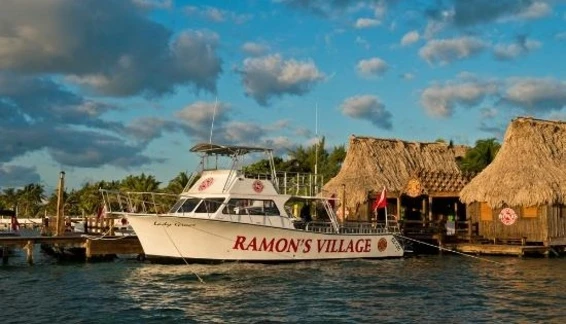
...Highlights: turtles, great macro life/ marine diversity,, schooling fish & big pelagics, non diving activities...
...Diving environment: healthy reefs, walls, drift diving, beginner and advanced divers...
Situated on the Caribbean mainland coast of Central America, Belize rightly deserves its reputation as one the region's best diving destinations. Whether you choose to stay in a resort or experience more of the destination by liveaboard safari, there is always a wealth of underwater riches in this Caribbean paradise. The warm, clear water of Belize means that diving conditions are often ideal for exploring the underwater realm.
Belize is home to the longest stretch of coral in the western hemisphere and, in addition to its barrier reef, it also boasts 3 distinct Caribbean atolls (Turneffe Reef, Lighthouse Reef and Glovers Reef). This means that you can enjoy diving a number of different coral reefs including walls, pinnacles and reef flats that are located throughout an enormous area of sea.
From shallow, clear reefs to spectacular drop offs, Belize diving caters to scuba-enthusiasts of every experience level. Lighthouse Reef is known for its breathtaking deep walls, soft coral and sponge gardens including some spectacular spur and groove formations. There is a great mix of large pelagics and small reef creatures, and it is home to the world famous Blue Hole.
Turneffe Atoll, being a series of mangroves, is a haven for juvenile species. There are some great drift dives here featuring larger marine animals. Then there are gentle, shallow reefs at Ambergris Caye where a marine reserve plays sanctuary to barracuda, sharks and rays. Home to a high level of species variety, Ambergris promises mangrove cayes, coral reefs, seagrass beds and lagoons, all offering something different.
Each of the major dive destinations offer shallow coral gardens or reef flats. This means that they are all suitable for casual and inexperienced divers. Both Lighthouse and Turneffe reefs have deep walls, making them more suitable for seasoned scuba divers too.
In addition to the spectacular atolls, cayes and scuba diving of Belize, there is a wealth of ancient Mayan ruins to discover and miles of tropical rainforest sheltering exotic species of birds, plants and animals. It is little wonder that visitors to Belize return again and again to enjoy the incredible natural beauty of this ancient land.
Whether you opt for a land-based stay or a liveaboard depends largely on where you wish to dive. The main attractions in Belize are:
Lighthouse Reef
This atoll is the most easterly situated area for Belize diving and furthest from the mainland. The sites feature walls, crests, coral gardens and sand flats, and it is home to the Blue Hole, made famous by Jacques Cousteau in 1970. The atoll features a variety of topography including some spectacular spur and groove formations. Here you can expect a mixture of large and small animals from flounders and neck crabs to sea turtles, sharks and rays.
The Blue Hole is of course the most famous site for Belize diving and one of the most famous in the world. We have all seen those awesome aerial images of a perfect blue circle. It can even be seen from space! Diving here is not for absolute beginners since good buoyancy control and an awareness of depth is important. It is a bucket-list dive because of its fame and the unique nature of the experience, rather than because of its marine life. The walls are mostly decorated not so much by coral (except in the shallows) but by sea plants, algae and feather-duster worms, Stalagmites rise from the floor where fallen stalactites tell the story of how this cave's ceiling collapsed to give the world the Great Blue Hole.
Half Moon Caye is a cute little island in southern Lighthouse Reef which has been granted national park status. Finning over sandy flats you should look out for torpedo rays, garden eels, sea hares and conches. Once on to the reef wall, you will dive around dome and boulder corals and through channels to the ocean side of the reef wall. Listen out for the distinctive chirping of the endemic toadfish (both large-eyed and white-lined) and keep an eye on the blue for eagle rays, black groupers, turtles and Caribbean reef sharks.
Colorful coral gardens are a feature of Belize diving and particularly here at sites such as Long Caye where sponges, sea plumes and sea rods all compete for space on the reef and create a tableau of pink, purple and beige. There is also healthy hard coral coverage including large brain corals and boulder star corals.
Tunnels, channels and swimthroughs are typical of the topography of Lighthouse Reef sites such as Tarpon Caves and Silver Caves. As you explore these interesting features, keep an eye out for great barracuda, Spanish hogfish, creole wrasses, and Nassau groupers. Smaller delights can include jawfish in their sandy burrows and arrow crabs among the corals.
This destination lies directly to the east of Belize City and is the nearest of the 3 atolls to the capital. This is an atoll covered in vegetation, unlike the others which are collections of sandy islands. Turneffe is a series of mangrove islands, lagoons and inlets. As such it is a haven for juvenile species. Dives here are on healthy reefs teeming with life. Turneffe is home to The Elbow - Belize's number one dive site for large shoals of schooling fish.
The Elbow is probably the jewel in the crown of Turneffe diving and one of the most fishy sites in all of Belize. it is a spawning aggregation site for groupers, cubera, dog, grey and mahogany snappers, plus horse-eye, bar and yellow jacks. The combination of surge, current and dizzying swarms of fish mean this is a site not for beginners. Few sites in the Caribbean can promise such a vast array and biomass of fish.
Another southern site of note is Sayonara, the shallow wreck of a former passenger boat. Little remains of the original wreck but the reef is excellent. Coral bommies and giant barrel sponges from the base for multi-colored sponges in hues of yellow and red. Marine life you might spot here includes peacock flounders, barracuda, queen angelfish and stoplight parrotfish.
Some of the best sites on the eastern edge of the atoll, near Blackbird Caye, include originally-named dive sites like Stingray Motel and Chinaman's Wall! Unsurprisingly the former is a good site to see stingrays, but also schools of horse-eye jacks, tilefish and more. There are often schools of squid passing over the reef. For very lucky divers you might even come across a pod of dolphins or even a manatee or 2! In the blue off Chinaman's Wall look out for Nassau grouper, barracuda, blacktips and eagle rays.
Among the best sites in the north-east is Lindsey's Back Porch, a steep wall which has plenty going on including sharks and groupers in the blue. However is really known for its shallower reef sections. There are 3 large parrotfish species sighted here: the midnight parrotfish, blue parrotfish and the rainbow parrotfish. Other interesting passers-by include loggerhead turtles and a wide variety of nudibranchs including the fabulous yellow-lined sea goddess.
Not far away is Lettuce Lane, so named after the proliferation of lettuce corals here. Sadly natural occurrences including hurricanes have put paid to the fields of pristine but delicate leaves that the shallows here used to boast. However the name lives on in the yellow-green nudibranch often spotted here. It has an unusual twisted body-shape as is referred to as the lettuce sea slug.
This is the biggest and most northerly of the off-shore cayes and enjoys a location about 1.25 miles (2 km) from some 22 miles (35 km) of barrier reef. The dive sites dotted along the reef offer good variety, including canyons, swimthroughs, grass flats, mangroves, channels and drop-offs.
Just 4 miles from San Pedro you can dive, and snorkel, in the Hol Chan Marine reserve on sites like Hol Chan (the Cut) a signature site on the barrier reef, popular within the Belize diving community. The prolific fish life here includes tarpons, grunts, cubera and dog snapper, and swarms of schoolmasters. More experienced divers can fin out to the drop-off where spotted eagle rays may cruise past large schools of southern sennet.
Mexico Tunnels is a fun site not far from San Pedro where there is a long deep gully (almost a tunnel) that you can swim through. Although it feels like you are in a tunnel, there is plenty of light and lots of 'escape hatches'. For company in the tunnel there are hogfish, tiger groupers and longspine squirrelfish. The reef flat features little gorgonian fans and soft corals alongside trumpetfish, queen angelfish and butterflyfish.
Shark Ray Alley is a site for snorkeling that you will almost certainly experience if you are staying on Ambergris Caye. It is home to a number of nurse sharks and southern stingrays attracted by the entrails and off-cuts discarded into the water by local fishermen. While feeding the marine life is far from ideal, many visitors to Belize enjoy the experience and proximity of these larger creatures. Other fish present include silver porgy, blue runners and horse-eye jacks.
For some, this choice is a straight one between liveaboards and resorts. For more information on your diving options and travel information you need to visit, read our Belize liveaboard or dive resort sections.
Liveaboard cruises have the obvious benefit of being able to visit a wider area and allow you to be on top of the sites rather than have to take boat rides from the resort. Some people prefer to be stationed on dry land and to scuba dive the best sites within reach from a resort. The liveaboards allow you to make several dives at each of Turneffe Reef and Lighthouse Reef. Otherwise you can choose a resort at Turneffe or in Ambergris Caye where the focus is more on the local dive sites.
Belize is a year round scuba destination. February and March represent the driest months. March through June experiences occasional rainfall and August through October, "the wet season", represents the more likely period for hurricanes. Visibility remains constant year-round away from the mainland shore.
August through October tend to be the months with the warmest water temperatures at around 82 to 84°F (28 or 29°C). Even at the lower end of the annual water temperature range, Belize is very much a warm water diving destination. The temperature rarely dips below 79°F (26°C) even around the cooler months of January and February. Seldom would you need more than a shortie and many scuba divers choose not to use an exposure suit at all during the warmer months. Air temperatures remain relatively constant around the 80°F (27°C) mark.
Surface conditions can become more choppy in the dry season although this is usually restricted to the more exposed dive sites further from shore. It is possible that some of the more exposed sites might be off limits during this time.
The best conditions for Belize scuba diving are generally considered to be from March through December, although outside this period it is common to still find optimum conditions. The first few months of this period (March through June) are considered by some to represent the very best months. April through June is whale shark season in Placencia, in the south of the country. October and November is when thousands of groupers mate and give birth to their young in the shallows of the cayes.
Review our map below of this country and its location in the world. Here, you will find information on how to get to Belize.
Reef Summary
Depth
16 - > 131 ft (5 - >40m)
Visibility
33 - 131 ft (10 - 40m)
Currents
None to gentle
Surface conditions
Mostly calm but can be choppy further from shore
Water temperature
79 - 84°F (26 - 29°C)
Experience level
Beginner - advanced
Number of dive sites
>125
Recommended length of stay
2 - 3 weeks
DIVE THE WORLD
TESTIMONIAL
Julia Bertsch
Germany
Great that I got offers somewhat quick and had a chance to decide where I wanted to go. Great is that there are so many possibilities to go scuba diving around the world, and where ever people go they'll find a PADI instructor, not to speak of the nice offers (dive = hotel/resort) and nice prices too