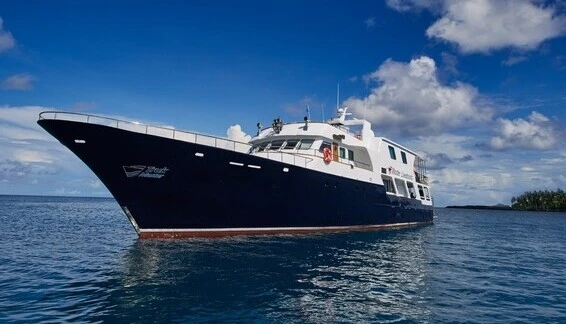
Dive experience: Advanced certification and 40 logged dives are recommended for most liveaboard tours on the Solomons Master. However, the special dedicated wreck cruises require advanced certification and 75 logged dives.
We strongly recommend that you have previous experience and are comfortable with drift dives, negative entries and deploying an SMB. Diving in some parts of both the Solomons can be challenging with strong currents. While the wrecks on the wreck itineraries are within recreational limits, it would be highly beneficial to be qualified to dive to at least 40m and to have experience of wreck penetration.
Cruise price per person includes: Local hotel/airport transfers to/from the boat, cabin accommodation, breakfast, lunch, dinner, snacks, drinking water, hot drinks, dives (as detailed in the trips above), 3 experienced dive guides, tanks, weights and weightbelts, sales tax.
Cruise price per person excludes (mandatory, unless customer provides own): Scuba equipment rental (incl dive computer USD 308 per week), port and park fees (7 nights - USD 175, 10 nights - USD 250), diving insurance, fuel surcharge (USD 11 per night) payable in advance directly to the liveaboard. Unless otherwise stated, all the listed items need to be paid on arrival (cash or credit card).
Optional extras: Alcoholic drinks, soft drinks, nitrox fills for enriched air certified divers (USD 200 per week), diving computer (USD 78 per day), torch (USD 100 per day), 13.2 litre tank (USD 39 per day). Unless otherwise stated, all the listed items need to be paid on arrival. Note: prices of items purchased onboard are subject to change.
How to get there: The Solomons Master uses 2 ports for its liveaboard trips in the Solomons:
Honiara - Coral Sea Resort in the capital city of the Solomon Islands is the principal port used.
Munda - Agnes Lodge Dock in the Western Province of the Solomons is used for some itineraries. There are daily direct domestic flights to Munda Airport (MUA) from Honiara with Solomon Airlines that take just over an hour.
Transfers are provided from local hotels/airports. Boarding time on the first day is at 6 pm, with the boat leaving port within the next 2 hours. The boat returns by 10 pm on the penultimate day and disembarkation is at 9 am on the last day. There will be 2 planned dives scheduled on the second last day of the trip. Please wait at least 18 hours before flying after diving. For more details, including airlines, see our Solomon Islands travel information section.
Non-diver rate: 10% discount off the published price (discount can not be combined with any other special offer).
Single supplement (if you do not want to share accommodation): This is optional - single travelers may choose to share a cabin or pay a supplement of 80% of the normal published price for their own cabin.
Dive clubs and group discounts: Pay for 7 guests and 1 additional person can join the cruise free of charge in the lowest priced cabin (total 8+ guests).
Whole boat charter rate (per night): Pay for 14 guests and 2 additional persons can join free of charge in the lowest priced cabin.
For experienced scuba divers, the Solomon Islands represent something increasingly rare: a true frontier. This far-flung archipelago, lying at the heart of the Coral Triangle, offers reefs and wrecks that have seen few divers. The sheer biodiversity here is extraordinary, and the sense of discovery is palpable. The vessel that takes you to these remote waters needs to be as capable as it is comfortable, and that is precisely where the Solomons Master liveaboard comes into its own.
A 34-metre steel-hulled liveaboard, the Solomons Master (formerly well-known as the Truk Master) combines robust seafaring with genuine comfort for up to 16 guests. The 8 cabins, split between Classic, Premium, and Superior categories, all offer private en-suite facilities and individually controlled air-conditioning - a welcome retreat after a day of diving. The social heart of the boat is found on the main and upper decks: an indoor lounge and bar with a plasma screen for reviewing the day’s images, a shaded outdoor area for escaping the tropical sun, and a sundeck perfect for simply watching the jungle-clad islands pass by.
The Solomons Master's dive deck is arranged for efficiency and ease. Each diver has a personal station for their kit, with under-bench storage, and the central camera table and dedicated preparation room with charging points show that this is a boat run by people who understand a diver’s workflow. 2 well-maintained tenders get you to the sites quickly, and the inclusion of a deco-bar and onboard defibrillator underscores the serious approach to safety. Technical divers will also find the Solomons Master liveaboard well set up for their needs, including rebreather support.
What truly sets an experience like this apart, however, is the Solomons Master dive team on board. Reviews consistently point to the expertise and genuine enthusiasm of the cruise directors and guides. They know these waters intimately, leading groups through dramatic seascapes: from stunning reefs and labyrinthine caves to the haunting, history-laden wrecks of WWII. Their briefings are thorough, their eye for the small, unusual critters as sharp as their awareness of the bigger picture, and their willingness to share knowledge after a dive adds real depth to the experience.
When the diving day is done, the conviviality continues. Guests gather in the lounge or out on deck to share stories over a drink, while the galley team serves up hearty, well-regarded Western-style meals. It is this blend of adventure and genuine hospitality that makes a week onboard feel both significant and relaxing. For the diver seeking to push their logbook into truly remote waters, with a crew that knows how to unlock the best of the region, the Solomons Master liveaboard is a proven and excellent choice.
Solomon Islands (11 Days / 10 Nights - 34 Dives)
Trip highlights: shark action, dolphins, manta rays, great macro life/ marine diversity, schooling fish & big pelagics, non diving activities
Diving environment: advanced divers, beginner divers, caverns, healthy reefs, off the beaten track, wall diving, wreck diving
Dive sites and activities: Russell Islands: Leru Cut, White Beach, Custom Caves, Rainbow Reef, Mirror Pond, Karumolun Point; Mary Island, Florida Islands: Twin Tunnels, Tulagi, Maravagi Bay, Tanavula Point, Mavis Seaplane, Ghavutu Island, Devil’s Highway, Baby Cakes; Marovo Lagoon; Kavachi Corner, Wickham Harbur, Mbulo Island. Village visit to see traditional family life.
Day 1
Boarding the Solomons Master liveaboard takes place in the late afternoon at the dock in Honiara. After a welcome from the cruise director and a safety briefing, you'll be shown to your cabin and have time to settle in before dinner. The vessel remains in port overnight, with the first dives scheduled for the morning after the boat has made its way towards the Florida Islands.
Core Days
The next 10 days the liveaboard visits the central and western Solomon Islands, from the Florida Islands across to the Russell group and onwards to Marovo Lagoon and Mbulo Island. In the Florida Islands, the diving is shaped by history and geology. Twin Tunnels cuts through the reef with 2 swim-throughs lined with soft corals, where silvery baitfish hover and barracuda patrol the edges. At Tanavula Point, the wall drops steeply, home to schools of chevron barracuda and the occasional grey reef shark. The wreck of the Mavis Seaplane rests in the shallows off Tulagi, its frame now a reef itself, encrusted with crinoids and anemones. Devil's Highway is a drift dive along a current-swept wall where schools of jacks and tuna pass by, while Baby Cakes is a shallow reef garden thick with anemonefish and nudibranchs.
In the Russell Islands, the topography shifts. Leru Cut is a narrow chasm through a limestone islet, where shafts of sun pierce the gloom and the walls are layered with soft corals and sea fans. Swim through at slack water and you emerge into a quiet bay where batfish gather. At Rainbow Reef, the hard corals are dense and healthy, home to clusters of anemonefish and passing turtles. Karumolun Point offers a drift along a wall dotted with sea whips. Nearby, the Custom Caves are shallow grottoes where shafts of light illuminate stalactites and resting white-tip reef sharks. And White Beach is a stretch of sand littered with WWII military hardware, such as trucks, landing craft, and ammunition cases, now host to clouds of cardinalfish and the occasional crocodilefish lying in ambush.
Further west, the scale expands. Marovo Lagoon is a vast, sheltered system of reefs and passages; here, Japanese transport vessels from the war rest on the sand, their hulls now draped in soft corals and swarming with glassfish. Kavachi Corner, named for a nearby submarine volcano, is a current-swept point where grey reef sharks and dogtooth tuna patrol the drop-off. At Wickham Harbour, the reef is thick with gorgonians, and pygmy seahorses cling to the sea fans. And at Mbulo Island, the wall plunges into darkness, home to sharks, and the corals here are in exceptional condition - thick hard and soft corals, giant sea fans, and clouds of anthias.
One afternoon, the the Solomons Master liveaboard pauses for a village visit. It is a chance to step ashore, meet families, and see a different pace of life. The children are often keen for a game of football, and there may be singing or a small market. It is a reminder that this part of the world is not just about what lies beneath the waves, but the communities that live above them.
Day 11
After an early breakfast, there is time to gather your gear and say your goodbyes. Ddisembarkation is straightforward: a short walk down the gangway and onto dry land, with 10 days of reef, wreck, and island memories to take home.
Solomon Islands (Express) (8 Days / 7 Nights - 22 Dives)
Trip highlights: shark action, dolphins, manta rays, great macro life/ marine diversity, schooling fish & big pelagics, non diving activities
Diving environment: advanced divers, beginner divers, caverns, healthy reefs, off the beaten track, wall diving, wreck diving
Dive sites and activities: Russell Islands: Leru Cut, White Beach, Rainbow Reef, Mirror Pond, Karumolun Point; Mary Island, Florida Islands: Twin Tunnels, Tulagi, Maravagi Bay, Tanavula Point, Mavis Seaplane, Ghavutu Island. Village visit to see traditional family life.
Day 1
Boarding the Solomons Master liveaboard happens in the early evening at the dock in Honiara. After a welcome from the cruise director and a brief safety orientation, you’ll have time to settle into your cabin and get to know the vessel before dinner. The night is spent moored in the calm of the harbour, and the first dives are scheduled for the morning after the boat has made its way towards the Florida Islands.
Core Days
The next days are a tour through a part of the Pacific that feels genuinely remote. The Solomons Master cruise through the Florida and Russell Islands offers up to 4 dives daily, a mix of reef, cavern, and wreck environments, each with its own character. In the Florida Islands, Twin Tunnels cuts through the reef with 2 swim-throughs lined with soft corals, where silvery baitfish hover and barracuda patrol the edges. At Tanavula Point, the wall drops steeply, home to schools of chevron barracuda and the occasional grey reef shark. History lies beneath the surface here too. The wreck of the Mavis Seaplane rests in the shallows off Tulagi, its frame now a reef itself, encrusted with crinoids and anemones. Nearby, Ghavutu Island marks the site of an old WWII seaplane base; the reef is scattered with debris such as engines, propellers, and wing fragments, slowly being absorbed by the coral. These sites are not just relics; they are living reefs, thick with glassfish, lionfish, and nudibranchs.
Further west, in the Russell Islands, the topography shifts. Leru Cut is the standout: a narrow chasm slicing through a limestone islet, where shafts of sunlight pierce the gloom and the walls are covered in gorgonian fans. Swim through it at slack water and you emerge into a quiet bay of coral gardens. Mirror Pond, as its name suggests, is a sheltered pool ringed by jungle, its surface so still it reflects the sky. Below, batfish and jacks cruise past. At Rainbow Reef, the hard corals are dense and healthy, home to clusters of anemonefish and passing turtles. Karumolun Point offers a drift along a wall dotted with sea whips, where schools of surgeonfish and unicornfish graze in the current. And White Beach is exactly what it sounds like: a stretch of sand littered with WWII military hardware - trucks, landing craft, and ammunition cases - now host to clouds of cardinalfish and the occasional crocodilefish lying in ambush.
One afternoon, the diving pauses for a village visit. It is a chance to step onto a small island, meet families, and see a different pace of life. The children are often keen for a game of football, and there may be singing or a small market. It is a reminder that this part of the world is not just about what lies beneath the waves, but the communities that live above them.
Day 8
After an early breakfast, there is time to gather your gear and say your goodbyes. Transfers from the liveaboard to Honiara’s airport or a local hotel are provided, and the crew will help with your luggage. The boat returns to port the evening before, so disembarkation is straightforward - just a short walk down the gangway and onto dry land, with a week's worth of reef and wreck memories to take home.
Solomons - New Georgia (11 Days / 10 Nights - 34 Dives)
Trip highlights: shark action, dolphins, manta rays, great macro life/ marine diversity, schooling fish & big pelagics, non diving activities
Diving environment: advanced divers, beginner divers, caverns, healthy reefs, off the beaten track, wall diving, wreck diving
Dive sites and activities: Russell Islands: Leru Cut, White Beach, Custom Caves, Rainbow Reef, Mirror Pond, Karumolun Point; Mary Island, Marovo Lagoon; Kavachi Corner, Wickham Harbour, Taiyo, Mbulo Island; Munda: The Abyss. Visit to Skull Island, and a village visit to see traditional family life.
Day 1
Boarding the Solomons Master liveaboard takes place in the late afternoon at the dock in Honiara. After a welcome from the cruise director and a safety briefing, you’ll be shown to your cabin and have time to settle in before dinner. The vessel remains in port overnight, with the first dives scheduled for the morning after the boat has made its way towards Mary Island.
Core Days
The next 10 days with the Solomons Master trace an arc through the western Solomon Islands, from the Russell Islands across the New Georgia group to Munda. In the Russell Islands, the diving is defined by limestone and light. Leru Cut is a narrow chasm through an islet, where shafts of sun pierce the gloom and the walls are layered with soft corals and sea fans. Swim through at slack water and you emerge into a quiet bay where batfish gather. Mirror Pond is exactly what it sounds like: a sheltered pool ringed by jungle, its surface so still it reflects the sky. Below, schools of jacks cruise past. At Rainbow Reef, the hard corals are dense and healthy, home to clusters of anemonefish and passing turtles. Karumolun Point offers a drift along a wall dotted with sea whips, while White Beach is a stretch of sand littered with WWII military hardware - trucks, landing craft, and ammunition cases. Nearby, the Custom Caves are shallow grottoes where shafts of light illuminate stalactites and resting white-tip reef sharks.
At Mary Island, the reef slopes into deeper water, home to schools of barracuda and the occasional eagle ray. Marovo Lagoon is a vast, sheltered system of reefs and passages; here, Japanese transport vessels from the war rest on the sand, their hulls now draped in soft corals and swarming with glassfish. Kavachi Corner, named for a nearby submarine volcano, is a current-swept point where grey reef sharks and dogtooth tuna patrol the drop-off. At Wickham Harbour, the reef is thick with gorgonians, and pygmy seahorses cling to the sea fans. Taiyo is a fish aggregation site, where schools of jacks and barracuda circle in the blue. And at Mbulo Island, the wall plunges into darkness, sometimes home to silvertip sharks and passing hammerheads.
Munda is the western boundary of the expedition. Here, the reef drops into the deep water of Blanche Channel, and the diving is defined by scale. The Abyss is a wall that falls away to over 600 metres, where grey, blacktip, and whitetip reef sharks patrol the edge, and silvertips and hammerheads are occasional visitors. The corals are in exceptional condition: thick hard and soft corals, giant sea fans, and clouds of anthias. Eagle rays glide past, and dogtooth tuna sometimes tear through schools of baitfish.
One afternoon, the diving pauses for a visit to Skull Island, a small islet where the remains of headhunters are displayed in a traditional shrine. It is a quiet, sombre place, a reminder of the region’s pre-colonial history. Another day, there is a village visit: a chance to step ashore, meet families, and see a different pace of life. The children are often keen for a game of football, and there may be singing or a small market.
Day 11
After an early breakfast, there is time to gather your gear and say your goodbyes. Transfers to Munda Airport or a local hotel are included.
This Solomons Master liveaboard itinerary runs in both directions depending on the week, so check your embarkation point when booking - you may begin in Honiara and end in Munda, or the reverse.
Solomons (Tec Diver Special) (11 Days / 10 Nights - 22 Dives)
Trip highlights: shark action, dolphins, manta rays, great macro life/ marine diversity, schooling fish & big pelagics
Diving environment: advanced divers, beginner divers, caverns, healthy reefs, off the beaten track, wall diving, wreck diving
Dive sites and activities: Florida Islands: Tulagi, USS Kanawha, Mavis Seaplane, Ghavutu Island, RNZN Moa, USS Minneapolis, Catalina Airplane; Guadalcanal: Bonegi I, II, III., plus other wrecks to 50m deep.
Day 1
Board the Solomons Master liveaboard in the late afternoon and settle into your cabin. After a welcome from the cruise director, there’s a safety briefing and an outline of the days ahead. This cruise is designed for technical divers qualified beyond 50 metres, so you’ll have time to complete paperwork, organise technical equipment, and discuss gas requirements with the crew before dinner. The vessel remains in port overnight, with diving commencing in the morning.
Core Days
The waters of Iron Bottom Sound hold one of the largest concentrations of World War II wrecks anywhere on Earth. For the technical diver, this means access to vessels that rest beyond recreational limits, ships that went down in 1942 and 1943 and have seen few visitors since. Operating from the Solomons Master liveaboard, you’ll spend the first days among the Florida Islands, where the seabed around Tulagi holds multiple deep wrecks. The USS Kanawha, a fleet oiler sunk at 50 metres, sits upright with much of her superstructure intact. Nearby, the USS Minneapolis, her bow lost to torpedo damage, lies broken across the slope, her stern in deeper water where large propellers and rudder remain recognisable. The wreck of the RNZN Moa, a smaller corvette, rests at more moderate depth but rewards attention to detail, her guns and bridge are home to leaffish and long-nosed hawkfish.
Around Ghavutu Island, the Japanese Mavis seaplane lies in 2 main sections, its wings and engines spread across sand at 45 metres. A Catalina flying boat rests nearby, its fuselage open and accessible, with swim-throughs that reveal the interior structure now thick with soft coral. These are dives that require staged decompression, and the schedule allows for 1 or 2 extended bottom times per day, with surface intervals spent reviewing profiles or simply observing the jungle-covered shoreline.
Moving to Guadalcanal, the Bonegi sites offer different challenges. Bonegi I and II are Japanese transports beached during the war, their hulls beginning in shallows and sloping to beyond 50 metres. The deeper sections of these wrecks - engine rooms, propeller shafts, cargo holds - are the preserve of technical divers, where ambient light fades and the focus narrows to trimix and careful gas management. Bonegi III, a more dispersed wreck scattered to 60 metres, requires precise navigation and awareness of the sand slopes that surround it.
Between dives, there are opportunities to step ashore from the Solomons Master liveaboard. A village visit offers a glimpse of contemporary island life, and at certain locations, guides can point out wartime relics still visible in the jungle, a reminder that this history exists above the waterline as well as below.
Day 11
After breakfast, you’ll disembark the liveaboard at Honiara. Transport is provided to the airport or local hotels, marking the end of the expedition.
Solomons (Wreck Special) (8 Days / 7 Nights - 22 Dives)
Trip highlights: shark action, dolphins, manta rays, great macro life/ marine diversity, schooling fish & big pelagics, non diving activities
Diving environment: advanced divers, beginner divers, caverns, healthy reefs, off the beaten track, wall diving, wreck diving
Dive sites and activities: Russell Islands: White Beach, Wreck of the Ann; Florida Islands: Tulagi, USS Kanawha, Mavis Seaplane, Ghavutu Island, RNZN Moa, USS Minneapolis, Catalina Airplane; Guadalcanal: Bonegi I, II, III. Land visits to see historic WWII sites, and village visit to see traditional family life.
Day 1
Board the Solomons Master liveaboard in the late afternoon for this wreck diving special and settle into your cabin. You’ll receive a warm welcome from the crew, followed by a safety briefing and an outline of the days ahead. There’s time to unpack, complete dive paperwork, and get to know fellow guests over dinner before an overnight stay in port. Diving begins in the morning.
Core Days
Over the coming days, the Solomons Master liveaboard navigates the waters once known as Iron Bottom Sound, offering a journey through some of the Pacific’s most significant WWII history. In the Russell Islands, you might start at White Beach, a dispersed debris field from Allied wartime dumping, now encrusted with marine growth. Close by rests the Ann, a Japanese transport ship lying in two sections, her boilers and propeller providing a haven for reef fish. Moving into the Florida Islands, the waters around Tulagi hold multiple relics. The USS Kanawha, an oiler sunk in 1943, sits upright with much of her structure intact, while a Mavis seaplane, its long wings and engines still identifiable, lies in shallower sand. Ghavutu Island’s shoreline gives way to the wreck of the RNZN Moa, a corvette small enough to absorb in a single dive, and the massive USS Minneapolis, her bow blown off in battle, now a broken but impressive site scattered across the slope. A Catalina flying boat rests nearby, its fuselage home to batfish and leaf fish.
Off Guadalcanal, the 3 Bonegi sites offer different experiences: Bonegi I and II are the remains of Japanese transports, their large propellers and cargo holds accessible and rich with marine life. Bonegi III, a more scattered wreck, often rewards those paying attention to the sand around it.
Between dives, there are opportunities to step ashore. You can visit local villages to observe traditional family life, and at certain locations, guides point out relics of the war still present in the jungle - remnants of a past that sits quietly alongside the present.
Day 8
After an early breakfast, you’ll disembark the Solomons Master in Honiara. Transport is provided to the airport or local hotels, marking the end of the trip.
[Information is best estimate in ideal circumstances and subject to changes beyond our control. The itinerary is a guide only and may be adapted to best suit the weather, tides, currents, availability and other prevailing events. Price is for the cruise, not for an exact number of dives].
You wake to the gentle movement of the the Solomons Master liveaboard at anchor, the scent of coffee already drifting from the main deck. The routine is straightforward: an early briefing, then into the water before the sun climbs too high. 4 dives structure the day, but the pace never feels rushed. You surface, swap tanks, and have time to replay the dive in your mind before the next one. It is diving that respects your need for immersion, with the boat simply providing the reliable, comfortable backdrop.
Between dives, the air-conditioned dining room becomes a natural gathering point. Meals are served buffet-style, and the galley crew focuses on robust, satisfying food that fuels long days underwater. You might find a hearty Indonesian rendang sharing table space with a fresh pasta salad or a platter of grilled fish. Breakfast, as one returning guest noted, is substantial enough to set you up until lunch. The kitchen is also accustomed to accommodating dietary needs provided they have notice, they will work to adjust the menu. And when a mid-afternoon craving strikes, there aare always fresh fruit and snacks laid out.
The beverage station is always accessible, offering fruit juices, soft drinks, and a proper selection of teas and coffee, both instant and freshly brewed. As the sun begins to drop, the focus shifts to the bar. You can order a cold beer, a glass of wine, or something stronger from the cocktail list. The policy is a simple one: drinks come from the ship’s bar, which helps keep accounts straightforward and the onboard experience consistent for everyone.
Evenings on the Solomons Master liveaboard are a mix of shared experience and quiet decompression. After dinner, divers often gather in the lounge to scroll through the day’s photos on the plasma screen or simply talk through the dives. Others might head to the shaded upper deck, sinking into a lounger to listen to the lap of water against the hull. There is no forced entertainment; the days are full enough. The liveaboard crew, frequently praised in guest feedback, moves through these moments with a quiet attentiveness, ensuring cameras are charging, gear is secure, and glasses are topped up.