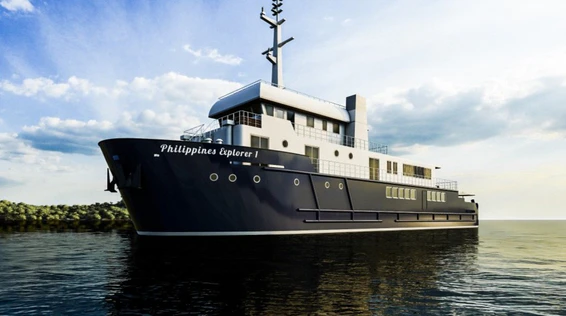
Notes: Child policy: Children aged 12 and above are accepted onboard the Philippines Explorer I. Children younger than that are done on a case-by-case basis. Child rates are the same as for adults.
Dive experience: All open water divers are accepted on trips, with the exception of Tubbataha. For Tubbataha, all divers must be minimum advanced open water with 30 prior logged dives.
Cruise price per person includes: Cabin accommodation with air-conditioning, breakfast, lunch, dinner, snacks, water, soft drinks and hot drinks, dives (as detailed in the trips above), experienced English-speaking divemasters (max. 5 diver per guide, tanks, weights and weightbelts, sales tax.
Cruise price per person excludes (mandatory, unless customer provides own): Scuba equipment (USD 200 per week), dive computer (USD 50 per week), port/park fees (from S$ 150 per trip), dive insurance. Unless otherwise stated, all the listed items need to be paid on arrival (cash - USD or PHP, or credit card (+4.5%).
Optional extras: Nitrox fills for enriched air certified divers (USD 120 per week), torch, 15 liter tanks (USD 30 per week), local airport and hotel transfers, alcoholic drinks, laundry. Unless otherwise stated, all the listed items need to be paid on arrival. Note: prices of items purchased onboard are subject to change.
How to get there: The ports used by the Philippines Explorer I depend on the trip route:
Tubbataha & Cagayancillo: These trips use Campomanes Bay in Barangay Maricalum in the southern part of Sipalay City, Negros Occidental. The nearest airports are Dumaguete (DGT, 5-6 hours by road) and Bacolod (BCD, 4 hours by road).
Tubbataha & Visayas: These trips use Campomanes Bay and Maya New Roro Port in Daanbantayan, at the northern end of Cebu Island. The nearest airport to Maya is Mactan-Cebu (CEB), 3 to 5 hours by road.
Visayas: These trips operate between Dauin and Donsol. Dauin is located just outside Dumaguete City (airport: DGT). Donsol can be reached 1.5 hours by road from Bicol International Airport (DRP) in Legazpi.
For more details, including airlines, see our Philippines travel information section.
Boarding is generally at the embarkation port between 1-2 pm. Disembarkation is latest by 10 am on the day of disembarkation. The final dive offered on each trip is generally in the late morning/early afternoon on the day before disembarkation. Philippines Explorer I follow the standard no-flying-after-diving rules of 18 hours before the departure flight, but they recommend 24 hours if multiple deep dives have been done as part of the trip.
Non-diver rate: No discount. The trips are specifically designed to include non-divers. Activities include expert-led land excursions, jungle treks, visiting remote islands, and other cultural experiences.
Single supplement (if you do not want to share accommodation): This is optional - there is a dedicated single guest cabin on Philippines Explorer I. Solo travellers may choose to share a cabin and pay the standard rate, book the single cabin, or pay a supplement of 50% for a double cabin.
Dive clubs and group discounts: Pay for 6 guests and 1 extra person can join the trip free of charge (7+ guests).
Whole boat charter rate (per night): Pay for 18 guests and 3 additional persons can join the cruise free of charge (total 21 guests).
When a vessel like the Philippines Explorer I liveaboard enters the Philippine diving scene, it does so with a rare combination of pedigree and purpose. This is not another refurbished dive boat. It is a 44-metre steel expedition vessel, originally built as a North Sea oil-rig support vessel and later serving as a Royal New Zealand Navy dive tender. Now, after a complete 2025-2027 rebuild, it is being reimagined as a hybrid diesel-electric liveaboard, designed for one thing: delivering the Philippines' finest dive sites with an unprecedented level of comfort and quiet.
The numbers tell part of the story. 11 above-waterline ensuite cabins accommodate just 21 guests on scheduled cruises - 22 on a full charter - supported by a crew of 18. That is an exceptionally high crew-to-guest ratio, and it reflects a fundamental choice: space over volume. Every cabin sits on the main deck or above, so there are no lower-deck berths. Several cabins feature private balconies. The dive deck is structured to reduce congestion, and the social areas feel more like a private yacht than a traditional dive platform. Add gyro stabilisers, a 1,110 kWh battery bank, and sound-insulated internal structures, and you have a vessel built for long-range expeditions to places like Tubbataha Reef, where comfort at sea is not a luxury but a necessity.
What truly sets the Philippines Explorer I liveaboard apart is the team behind it. The project marks the return of an industry pioneer who helped build the Siren Fleet and later Master Liveaboards. His track record is built on decades of delivering consistent, high-quality liveaboard experiences across Southeast Asia. This is an experienced operator re-entering the market with a clear vision: to elevate the Philippine liveaboard experience to the premium level that destinations like Indonesia and the Maldives have long enjoyed.
The Philippines Explorer I is designed for more than just scuba diving. The concept plans include kayaks, SUPs, a back-deck swimming pool with an optional swim-current, a fitness centre, and an onboard masseuse. There is even a small craft-beer brewery onboard. The galley will offer a mix of Asian and Western menus, with beach barbecues and flexible dietary preparation. Wi-Fi is available via Starlink, though it is a paid onboard package. The point is this: the Philippines Explorer I liveaboard is not just a dive platform. It is an adventure cruise, combining world-class diving with genuine land excursions, cultural experiences, and activities for non-divers.
The Philippines has never lacked credibility as a dive destination; its biodiversity ranks among the strongest globally. But the premium liveaboard segment has been dominated elsewhere, not because the diving is better, but because the infrastructure and positioning have lagged behind in the Philippines. The Philippines Explorer I steps directly into that gap. Its first Tubbataha programmes are scheduled from 2028, with the vessel planned to begin cruising in 2027. This is not a quiet re-entry. It is a deliberate move to set a new standard for liveaboard diving in the Philippines.
For the scuba diver who has visited Indonesia, the Maldives, and Palau, the Philippines Explorer I liveaboard offers something genuinely different: a chance to explore the Visayas and Tubbataha Reef from a vessel that prioritises space, comfort, and experience over passenger count. It is a boat built by a team that knows what divers want, because they have been delivering it for decades. And it is arriving at a time when the Philippines is finally ready for a liveaboard of this calibre. Book early. Spaces are limited, and the demand is already building.
There is 1 queen-double bed Premium Suite (24 sqm) on the bridge deck, 6 Deluxe Suites (14.5-15.5 sqm) on the upper deck - 4 double/twin bed and 2 double bed. On the main deck there are 3 Comfort double/twin bed cabins (20 sqm) and 1 Comfort single bed cabin (configurable as a twin on full charter basis only).
All the Philippines Explorer I cabins have:
- Individually controlled air conditioning
- Upper deck cabins have seaviews, main deck have portholes and/or small windows
- Private bathroom with toilet and hot water shower
- Hand basin, towels, toiletries and hair dryer
- Upper deck cabins have private balconies (slide doors)
- TV, video player and music in Premium Suite only
- Safe for personal belongings
- Cabinet and mirror
- Reading lights
- Mains outlet 220 volts - 24 hours per day
- Bedding and storage space
No. of bathrooms / showers - 11 / 11 - hot water
Tubbataha & Cagayancillo (11 Days / 10 Nights - 27 Dives)
Trip highlights: whale sharks, shark action, turtles, great macro life/ marine diversity, schooling fish & big pelagics
Diving environment: advanced divers, drift diving, healthy reefs, off the beaten track, wall diving
Dive sites and activities: Cagayan Islands: MV Forever Lucky wreck; Tubbataha North atoll; North Atoll's Ranger Station, Jessie Beazley Reef, Malayan Wreck, Shark Airport, Tubbataha South atoll: Delsan Wreck, Southwest Wall, Black Rock; Cavili and Arena islands, Calusa
Day 1
Boarding begins in the afternoon. Once everyone is aboard, there is a welcome drink, a cabin briefing and the safety drill, followed by time to assemble gear and get to know the crew and other guests. Philippines Explorer I remains at Campomanes Bay overnight before the crossing begins.
Core Days
The Cagayan Islands sit well away from the usual tourism routes, and they make a fine introduction to the region. Diving here may include the MV Forever Lucky wreck along with nearby reefs, where coral growth is healthy and fish life is plentiful. After 2 or 3 dives, the boat continues west towards Tubbataha, leaving land behind as the Sulu Sea opens up.
Tubbataha Reefs Natural Park is a UNESCO World Heritage Site and one of the most intact reef ecosystems in Southeast Asia. The North Atoll's Ranger Station area offers an excellent first taste of the park, with steep walls, healthy coral formations, reef sharks, turtles and large schools of fish. Between dives there is often a chance to visit the ranger station and learn about the conservation work that keeps the park protected. Jessie Beazley Reef, an isolated seamount northwest of the North Atoll, is exposed to strong currents and attracts jacks, barracuda, tuna and several shark species, with a full day dedicated to exploring it. A return to the North Atoll brings divers to the Malayan Wreck area, where the vessel's remains rest on the reef and the surrounding coral slopes and clear water are the real draw.
The South Atoll holds some of Tubbataha's best-known sites. At the Delsan Wreck area, jacks and barracuda gather around the reef corner, while dogtooth tuna, reef sharks and other pelagic species move through the blue beyond. The Southwest Wall shows a different side of the atoll, its coral-covered drop-offs falling away into deep water. Black Rock, another South Atoll favourite, comes to life when the current is running, drawing reef fish into the blue and larger predators along the current lines. On the final day at Tubbataha, the North Atoll's Shark Airport offers whitetip reef sharks resting on the sandy seabed, alongside turtles, rays and schooling fish.
Leaving Tubbataha behind, Philippines Explorer I liveaboard turns east through the Sulu Sea. Cavili and Arena Islands offer healthy reefs and clear water in a setting that sees very few dive boats. The following day is spent around Calusa Island and Cagayancillo, where traditional island communities and remote reefs sit side by side. Diving, island visits and time ashore round out the final full day of the trip.
Final day
Philippines Explorer I arrives back at Campomanes Bay in the morning, and the expedition ends after breakfast. For divers searching for pristine reefs, reliable pelagic action and a genuine sense of remoteness, this trip is difficult to beat. Get in touch to check dates and availability on the Philippines Explorer I.
[Information is best estimate in ideal circumstances and subject to changes beyond our control. The itinerary is a guide only and may be adapted to best suit the weather, tides, currents, availability and other prevailing events. Price is for the cruise, not for an exact number of dives].
Meals on the Philippines Explorer I liveaboard are served in the dining area on the upper deck, a layout that keeps breakfast, lunch and dinner close to the action without ever feeling rushed. The space sits above the main deck, so you eat with daylight and open views rather than below deck, and waiter service extends to all deck levels for guests who would rather take a plate somewhere quieter. It is a working liveaboard arrangement, but a comfortable one.
Cuisine leans on a fusion of Asian and Western cooking, prepared in a complete galley. Dietary requests can be accommodated when pre-requested at least 7 days before the cruise begins, and the kitchen treats that as a genuine commitment rather than a polite note.
Breakfast varies, but the constants are fresh fruit, yoghurt, granola, oats, toast and eggs cooked to order however you like them. From there it shifts with the day: pancakes, bacon, or Asian requests such as rice soup or noodle soup. Lunch moves between Western and Asian plates. You might see chicken or tuna salad wraps with potato salad or french fries, chicken or beef satay, fried rice, fried noodles, stir fried mixed vegetables, or burgers. Dinner opens with soup of the day and fresh homemade bread, then mains such as spaghetti bolognese, lasagne, mixed Thai dishes (green curry, tom kha, rice and mixed vegetables), lamb shoulder with roast potatoes, or steak with french fries and salad. Dessert is optional and usually a 'dessert of the day' - homemade ice cream in vanilla, chocolate or strawberry, and sometimes banana splits.
Snacks are free and available all day, a mix of cakes, cookies and savoury bites. The cook also prepares an afternoon snack, which might be banana fritters, a special cake or muffins, fresh or fried spring rolls, or a snack platter. Specialist chocolate from a local supplier is sold on board, but everything else is included. All meals and non-alcoholic beverages come with the cruise: soft drinks, freshly ground coffee, teas and herbal infusions. Wine and a cocktail selection are available, and there is a craft beer brewery on board. Beach BBQs are built into the itineraries as part of the cruise rather than charged as an extra.
Times shift with the itinerary. The Philippines Explorer I team plans diving around when other boats are elsewhere, so the schedule follows conditions and sites rather than a fixed clock. That said, the rhythm will feel familiar to anyone who has travelled on a liveaboard: an early light breakfast or hot drink before the first dive, a proper breakfast afterwards, then a second dive before lunch, a third in the afternoon, and often a dusk or night dive depending on the route. Between dives there is time to eat, rest and sort camera gear. The afternoon snack lands before the next briefing. Dinner is a sit-down affair in the evening, followed by desserts and the chance to review the day's footage or simply watch the water.
Beyond the table, the Philippines Explorer I offers more than most boats of her size. There is waiter service across every deck level, an onboard masseuse, a back deck swimming pool with an optional swim current, and a fitness centre for guests who want to keep moving between dives. It is a setup that suits divers on longer Philippines trips, where days settle into a comfortable pattern of diving, eating well and sleeping soundly. For divers comparing Philippines liveaboards, the food and daily routine are part of the decision. On the Philippines Explorer I liveaboard, they are a reason to book rather than something to tolerate.