Dive experience: At some of the Komodo dive sites, the water can vary from warm to quite cool, and waves and surface currents can make these dive sites quite challenging. The minimum number of logged dives to join a Nusantara liveaboard trip is 10, and all divers must have a minimum of open water, and Deep adventure dive (which can be taken onboard) and last dive within 6 months to 1 year depending on experience. Nusantara's highly experienced guides will choose the sites and dive times according to the experience level of the guests to make sure each dive is safe and suitable. The advanced course can also easily be integrated in to the trip to improve your skills, with a minimum number of 2 - this can be organised at check in.
Cruise price per person includes: Cabin accommodation, breakfast, lunch, dinner, snacks, drinking water, hot drinks, return transfers to the boat from the dive centre, dives (as detailed in the trips above), experienced English-speaking divemaster(s) (max. 4 divers per guide), scuba equipment, torch, tanks, weights and weightbelts, sales tax.
Cruise price per person excludes (mandatory, unless customer provides own): Komodo National Park fees (week days: USD 17 per day, Sundays and holidays: USD 19 per day) in cash (IDR only), trekking (USD 5 per day), (diving insurance (DAN insurance can be purchased onboard), fuel surcharge (2 nights USD 19; 3 nights USD 28). Unless otherwise stated, all the listed items need to be paid on arrival, cash (IDR only) and cards accepted.
Optional extras: Soft drinks, beer, dive computer (USD 7 per day), 15 litre tank (USD 10 per day). Unless otherwise stated, all the listed items need to be paid on arrival, cash (IDR only) and cards accepted. Note: prices of items purchased onboard are subject to change.
How to get there: Nusantara's liveaboard safaris depart at 9 am from Labuan Bajo, Flores (meet at the Mikumba Dive Centre at 8 am). You can fly direct to Labuan Bajo from Bali or Jakarta (and we can help you arrange this if necessary). You must check in between 9 am to 8 pm the day before cruise start date to complete registration form, size out your dive equipment and to pay the Komodo National park entrance fee. A speed boat will take you from the harbour, out to where the boat is moored, ready for departure by noon.
The last dive on all of these charters will be 1-2 pm on the final day, and then the boat returns and arrives in port for disembarkation at around 5 pm. Please wait at least 18 hours before flying after diving. For more details, including airlines, see our Komodo travel information section.
Non-diver rate: 5% discount.
Single supplement (if you do not want to share accommodation): This is not available on this boat.
Dive clubs and group discounts: See whole boat charter rate below.
Whole boat charter rate (per night): Pay for 11 guests and 1 additional person can join free of charge (max. 12 guests).
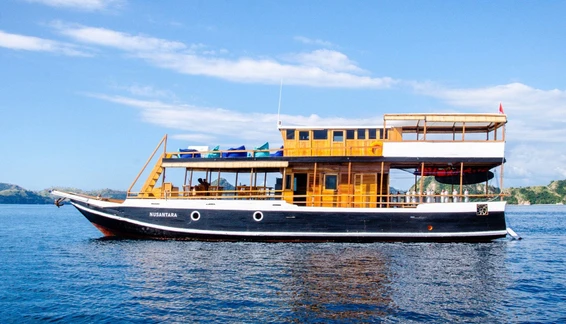
Nusantara is an economy liveaboard safari boat that operates 3-5 night diving trips in Komodo all year round where you will encounter stunning healthy coral reefs, stupendous amounts of colourful fish, friendly turtles, dolphins and majestic mantas.
The ironwood and teak boat was built in 2017, is 21m long and 3m wide, carries a maximum of just 12 scuba divers, and underwent a major overhaul in 2021, meaning she now looks like brand-new. Nusantara will provide the personalised attention you desire, take you to the best spots and keep you away from the crowds.
The accommodation onboard is perfect for backpackers and young travelers that prefer to enjoy the diving adventure than to worry about how many stars the boat might earn. There is a dorm cabin below deck that sleeps 8. The beds have privacy curtains, fans, a light, power sockets and storage space. There are also 4 mattresses on the upper deck where guests can sleep in the covered area under the stars, ideal for those clear nights with a delightful ocean breeze.
The dive deck is at the back of the boat where divers gear up and jump straight off the platform. After the dives there are 2 bathrooms with western style toilets and hot showers to freshen up and rinse off the salt water. Then at the end of the day you can relax and enjoy an ice cold beer or a soft drink, while the dive guides and boat crew sing and play guitar, watching the sunset as Nusantara cruises through the park.
The dining area is at the front of the main deck, and up on top there is an open sun deck and a shaded area, perfect for taking a nap or reading a book on one of the comfy beanbags. Other activities on these Nusantara liveaboard cruises include snorkeling, stand up paddleboard, beach walks, board games, FISH ID books, and simply enjoying the delicious food.
Safety features onboard the Nusantara include SART, EPIRB, GPS, VHF radio, as well as smoke alarms, fire extinguishers, life jackets, life rings, flares and a life boat. There is also a satellite phone for emergencies, a cruise director, dive guides, and 5 experienced boat crew. The boat carries emergency oxygen, first aid kits, as well as a 40 HP speedboat.
Nusantara accommodates 8 guests in a dorm cabin on the lower deck, as well as 4 guests on mattresses in a covered but open plan section of the upper deck. All guests share 2 bathrooms with a toilet, hot water showers, hand basin, towels and toiletries, as well as an extra shower head on the dive deck.
The cabin has:
- Individual fan cooling
- Privacy curtains
- Reading lights
- Bedding and luggage space
- Daily housekeeping
- 24-hour, 220v electricity supply
- Smoke alarm, life jackets and fire extinguishers
No. of bathrooms / showers - 2 / 3 - hot water
Komodo National Park North
Trip highlights: shark action, dolphins, manta rays, dugongs/manatees, turtles, great macro life/ marine diversity, schooling fish & big pelagics, non diving activities
Diving environment: advanced divers, drift diving, healthy reefs, very popular, wall diving
Dive sites and activities: from Sebayur Kecil, Central Komodo, Wainilu, Batu Bolong, Tatawa Besar, Karang Makassar, Mawan, Gili Lawa: Castle Rock, Crystal Rock, The Cauldron, bats at Kalong, and Komodo dragon land visit on Rinca
Day 1
You step aboard the Nusantara liveaboard in Labuan Bajo with a welcome drink, then meet the crew and dive guides over a safety briefing. After setting up your gear, you cruise towards Sebayur Kecil for a gentle check dive, a chance to dial in your weights and get comfortable with the guides. A second dive follows in central Komodo, then the boat moves to Kalong Island as dusk falls. That is when the fruit bats take flight, thousands of them streaming across the sky. You watch from the deck with dinner, then finish the day with a night dive at Wainilu, where the sand glows with bioluminescence and sleeping fish tuck into crevices.
Core Days
The Nusantara spends its days working through northern Komodo's most celebrated dive sites, each with a distinct character. At Wainilu you slow right down. This is muck diving at its best: frogfish disguised as sponges, pygmy seahorses clinging to sea fans, and the occasional flamboyant cuttlefish flashing purple across the sand. From there you move to Batu Bolong, a rocky spire that punches up from deep water. Current sweeps past both sides, drawing in grey reef sharks, dogtooth tuna, and clouds of anthias that turn the water red. You tuck behind the pinnacle's lee side, then release into the flow. The Nusantara guides know exactly when to hit each site for the slackest current.
Tatawa Besar offers a gentler drift along a coral-encrusted slope. You glide past gorgonian fans while turtles nap under overhangs and bumphead parrotfish graze on the reef top. Then comes Karang Makassar, also known as Manta Point. You kneel on the sandy bottom at 12 metres, watching giant mantas cruise your bubbles. They come close enough to count their spots, then peel off into the blue. Mawan, a nearby seamount, delivers the same cleaning station action with fewer boats. Choosing the Nusantara liveaboard means you hit these sites when the day boats are elsewhere.
The northern pinnacles, Castle Rock and Crystal Rock, sit within current-swept channels. These are big fish sites. Schools of jacks and barracuda hold station against the flow, while whitetip reef sharks rest on ledges. If the tide runs hard, you hook into the rock and let the water rush past, watching as hunting trevallies pick off smaller fish. The Cauldron, a tight channel between Gili Lawa islands, demands respect. You drop in at slack tide and drift through a narrow canyon, the walls coated in soft corals. Reef sharks patrol the exit, and eagle rays often glide overhead.
Between dives, Nusantara anchors near Kalong again for the bat spectacle, a quiet ritual that never gets old. And on one morning, you trade fins for boots. A short trek on Rinca Island puts you face to face with Komodo dragons. The rangers lead you across dry savanah to where the lizards bask near the watering holes. They are slow, deliberate, and utterly prehistoric. You keep your distance, but you feel their attention.
Final Day
Your last day starts early. 3 dives in northern Komodo, perhaps a return to Crystal Rock or a final drift at Tatawa Besar, then Nusantara turns south. You eat breakfast and lunch underway, reviewing the week's sightings with other guests. The boat reaches Labuan Bajo in the late afternoon. You pack your gear, swap contacts with new dive friends, and step ashore with a logbook full of entries that most divers only dream of.
Komodo National Park South (4 Days / 3 Nights - 12 Dives)
Trip highlights: shark action, manta rays, dugongs/manatees, turtles, great macro life/ marine diversity, schooling fish & big pelagics, non diving activities
Diving environment: advanced divers, drift diving, healthy reefs, very popular, wall diving
Dive sites and activities: South Komodo: Horseshoe Bay, Nusa Kode, Manta Alley, South Rinca, Padar Island. sunset hike, and Komodo dragon viewing
Day 1
You step onto the Nusantara liveaboard in Labuan Bajo with a welcome drink, then meet the crew and dive guides over a safety briefing. After setting up your gear, the boat heads south into the park. Your check dive takes place in the protected waters of Horseshoe Bay: calm, clear, and a gentle reintroduction to buoyancy. A second dive follows at Nusa Kode, where the underwater topography begins to hint at what southern Komodo does best. Then comes a speedboat trip to the beach, where you watch Komodo dragons from a respectful distance as they patrol the shoreline. Back on board, a night dive reveals sleeping parrotfish and hunting lionfish before dinner.
Core Days
Southern Komodo is different from the north. Fewer boats. Stronger currents. Bigger surprises. The Nusantara spends its core days working through this less-visited region, where the water runs colder and the marine life responds accordingly. Manta Alley lives up to its name. You drop onto a cleaning station at 15 metres, then wait. The mantas come in close, sometimes a pair, sometimes a squadron, gliding just above your head as cleaner fish pick parasites from their gills. They circle back repeatedly, unbothered by your bubbles. Between passes, look for the eagle rays that often join the formation.
South Rinca offers a different pace. Here, the current pushes against a series of rocky islets, creating nutrient-rich upwellings. You drift along a slope scattered with table corals and massive porites bommies. Reef sharks patrol the edge. Schools of jacks hold station against the flow. And if the tide is right, you may spot dogtooth tuna blasting through the blue. The Nusantara guides know exactly where to position divers for the best views.
Nusa Kode delivers a wall dive that drops from 5 metres to beyond recreational limits. The wall is plastered in soft corals - lavender, orange, deep red - with sea fans the size of small trees. Turtles rest on ledges. White tip sharks sleep in sandy alcoves. And at the wall's base, beyond 35 metres, experienced divers can sometimes find schooling hammerheads passing through. That sighting is rare, but it happens often enough that South Rinca has earned a reputation among those who chase the unusual.
Between dives, Nusantara anchors near Padar Island in time for the sunset hike. You climb the dry ridge to the viewpoint, looking down at 3 bays with sand in different colours: black, pink, white. The light changes fast. The boats in the harbour shrink to specks. It is a quiet moment, and a reminder that Komodo rewards patience above the surface as much as below it.
Day 4
The last morning starts early. 3 dives in southern Komodo, perhaps a return to Manta Alley or a final drift at Nusa Kode, then Nusantara turns north. You eat breakfast and lunch underway, reviewing the week's sightings with other guests. The boat reaches Labuan Bajo in the late afternoon. You pack your gear, swap contacts with new dive friends, and step ashore with a logbook full of southern Komodo's wildest moments.
[Information is best estimate in ideal circumstances and subject to changes beyond our control. The itinerary is a guide only and may be adapted to best suit the weather, tides, currents, availability and other prevailing events. Price is for the cruise, not for an exact number of dives].
A typical day on the Nusantara liveaboard starts early. The crew puts out a light pre-breakfast at 6 am of tea, coffee, biscuits, and fresh fruit to fuel you before the first dive. You roll out of bed, pull on your wetsuit, and step onto the dive deck. After the morning dive, you return to a proper breakfast at 8:30 am. Think eggs cooked to order, fried rice, noodles, fresh tropical fruit, and local breads. The dining area on the main deck becomes the gathering point, everyone comparing notes on what they saw.
By 12 noon, lunch is served buffet style. Nusantara's chef prepares a mix of Indonesian and international dishes. One day you might get beef rendang, slow-cooked coconut beef with spices, alongside rice, vegetables, and a simple salad. Another day brings soto ayam, a fragrant chicken soup with turmeric and lime. Nasi campur, a plate of rice with small portions of various dishes, appears regularly. There is always a vegetarian option, and the crew accommodates dietary requests if you let them know in advance.
After lunch, the Nusantara moves to the next site. The afternoon dive happens around 2 pm. Between dives, guests spread out across the boat. Some head to the huge sun deck at the front, sinking into oversized beanbags with a book. Others take a nap on the shaded rear deck or review fish ID guides in the communal area. 2 shared bathrooms with western toilets and showers let you rinse off the salt. Soft drinks and beer are available for purchase, a cold Bintang tastes especially good while watching the sun drop behind the islands.
A late afternoon snack arrives around 5 pm, just before the night dive briefing. The Nusantara liveaboard typically schedules the night dive for 6 pm, returning to the boat as the sky turns dark. Dinner follows at 7:30 pm. The evening meal might feature grilled fish, sustainably line-caught from outside the park, with steamed vegetables, rice, and a local sambal. Dessert is often fresh fruit or a simple sweet pudding.
After dinner, the dive guides and crew sometimes bring out a guitar. Singing, conversation, and planning tomorrow's dives carry on until the boat rocks you to sleep. Tea, coffee, and drinking water remain available at all hours. The rhythm repeats daily, but the dives and the company keep it from ever feeling routine.