Notes: Child policy: We only accept children aged 12 and above onboard Coralia Liveaboards. Children 12 and above are priced the same as an individual adult.
Dive experience: Coralia offers beginner courses on board, so technically no prior dive experience is required but, of course, the more you have, the better. You will dive in small groups on the liveaboard and the dive groups are arranged according to experience level and other preferences such as, for example, photography.
Cruise price per person includes: Cabin accommodation, breakfast, lunch, dinner, snacks, soft drinks, hot drinks, drinking water, scheduled shore activities/excursions, round trip transfers to the local airport, dives (as detailed in the trips above), nitrox fills for enriched air certified divers, experienced English-speaking divemaster(s) (max. 4 divers per guide), 12 litre aluminium tanks (DIN as well as INT), weights and weightbelts, sales tax.
Cruise price per person excludes (mandatory, unless customer provides own): Scuba equipment (USD 230 per week), dive computer (USD 60 per week), port/park fees (from USD 285 per trip), diving insurance. Fuel surcharge (from USD 27 per night). Unless otherwise stated, all the listed items need to be paid on arrival, cash (IDR, EUR and USD) and cards accepted (+3%).
Optional extras: Alcoholic drinks, laundry service, torch (USD 10 per day), 15 litre tank (USD 5 per day). Unless otherwise stated, all the listed items need to be paid on arrival. Note: prices of items purchased onboard are subject to change.
How to get there: Most ports in Indonesia can be accessed via direct flights from Bali or Jakarta. For more details, including airlines, see our travel information section. The crew will pick you up at the local airport of embarkation and assist you to the Coralia Dua liveaboard.
Raja Ampat - Your flight should land in Sorong airport (SOQ) 2 pm at the latest, but earlier is also fine. For tours ending in Sorong, your flight departure can be anytime on disembarkation day.
Ambon (AMQ), Manokwari (MKW), Ternate (TTE), Manado (MDC), Kaimana (KNG) - For tours starting out from the above-mentioned ports, your arrival flight should land 2 pm latest on embarkation day, and on disembarking day your flight can depart any time.
Maumere (MOF), Labuan Bajo (LBJ) - For tours from these ports, your arrival flight should land 1 pm latest on embarkation day, and on disembarking day your departure flight can depart any time.
Bima (BMU) - Your arrival flight should land on embarkation day at 12 noon latest, and on disembarking day your departure flight can depart any time.
Saumlaki (SXK) - Your arrival flight should land on embarkation day at 10 am latest, and on disembarking day your flight can depart any time.
Bali (DPS) - For these tours your flight should land in Denpasar by 10 am or earlier. For tours ending in Bali, we recommend to book flights departing from Denpasar in the late afternoon or evening only.
At the end of the tour, the crew will assist you from the liveaboard to the airport of disembarkation, latest 10 am. The last dive of each Coralia Dua trip will be during the morning on the penultimate day at 10:30-11 am. Please wait at least 18 hours before flying after diving.
Non-diver rate: None.
Single supplement (if you do not want to share accommodation): This is optional - solo travellers may choose to share a cabin and pay the standard rate, or pay a supplement of 55% for their own cabin.
Dive clubs and group discounts: 10% discount for triple-share in the lower deck cabins. Else, pay for 7 guests and 1 extra person can join the tour free of charge (max. 8-15 guests).
Whole boat charter rate (per night): Pay for 14 guests and 2 additional persons can join free of charge (max. 16 guests).
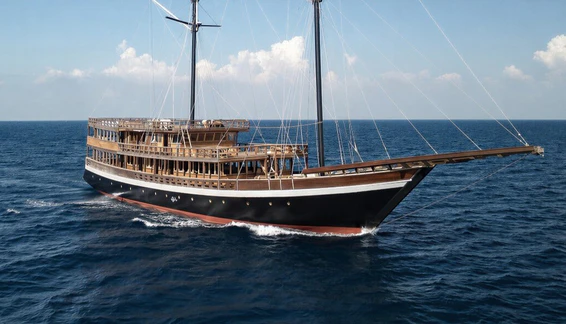
The Coralia Dua liveaboard represents the next generation of luxury phinisi cruising in Indonesia. Launching in 2026 as the sister vessel to the award-winning Coralia, this 51.8-metre traditional wooden phinisi was designed to elevate the guest experience with enhanced space, refined amenities, and a focus on the details that matter to scuba divers and photographers alike. The vessel operates across Indonesia's most celebrated diving regions, including Raja Ampat, the Banda Sea, Halmahera, Cenderawasih Bay, and the Forgotten Islands.
What sets the Coralia Dua apart is its remarkable crew-to-guest ratio. With 21 crew members and 2 cruise directors serving a maximum of just 16 guests, the level of personal attention is exceptional. This intimate capacity means dive groups remain small, with a maximum of 4 divers per guide, allowing for careful supervision and dives tailored to the group's experience and interests. The vessel's 8 en-suite cabins include 4 Master Cabins of 35 square metres on the main and upper decks, each with a private deck overlooking the ocean, and 4 Deluxe Cabins on the lower deck offering double or twin configurations .
For underwater photographers, the Coralia Dua liveaboard is particularly well-equipped. A dedicated full-width camera room provides individual workstations, ample storage, and multiple charging points, making it a standout choice for those who want to capture the region's extraordinary marine life. The dive deck is expansive, and the vessel carries 11-litre, 15-litre, and 8-litre tanks, supported by 2 Bauer compressors and an NRC Nitrox membrane system. Nitrox is included free of charge for certified divers.
The operator behind Coralia Dua brings a proven track record of safety and service. Coralia Liveaboards was awarded the #1 spot for Level of Safety in Scuba Diving Magazine's 2026 Readers Choice Awards. The fleet is connected to the team behind Papua Explorers Dive Resort in Raja Ampat, an operation recognised for its commitment to marine conservation and community engagement. This foundation shapes every aspect of the Coralia Dua experience, from crew training to itinerary design.
Dining aboard the Coralia Dua follows the same philosophy as its sister ship, with chefs preparing generous, balanced meals that blend Indonesian flavours with international favourites. The atmosphere is relaxed and welcoming, with outdoor dining areas and multiple lounging spaces across the decks. An onboard masseuse offers treatments after a day of diving, and the vessel features warm towels and the operator's signature hot chocolate after night dives.
The Coralia Dua represents a considered evolution of the liveaboard model, combining traditional Indonesian craftsmanship with modern amenities and an unwavering focus on the diving experience. For those seeking a premium Indonesian liveaboard adventure with exceptional service and facilities designed for serious divers and photographers, the Coralia Dua is worth special attention.
Cenderawasih Bay
Trip highlights: whale sharks, manta rays, great macro life/ marine diversity
Diving environment: advanced divers, beginner divers, healthy reefs, off the beaten track, wreck diving
Dive sites and activities: Cenderawasih Bay: Pulau Purup, Roon, Pulau Rippon, Tanjung Mangguar, Kwatisore Bay, Bagans, Tridacna Atoll, Manokwari.
Trips that use Sorong Harbour will also visit Pulau Amsterdam.
Day 1
Your expedition begins on arrival in Manokwari, where the team will meet you and transfer you to the yacht. Once aboard the Coralia Dua liveaboard, you will settle into your cabin and set up your dive gear while the cruise director runs through safety procedures and the week ahead. Dinner is served as the vessel heads out overnight towards the national park, with cylinders filled and ready for the first dive the next morning.
Core Days
Cenderawasih Bay sits on the western edge of the Bird's Head Seascape and is Indonesia's largest marine protected area. It sees very little dive traffic, and much of the coastline is uninhabited. The coral diversity here is remarkable, with over 500 species recorded, and the hard coral gardens are among the healthiest in the region. The trip opens at Pulau Purup, where a full day is spent across several sites. The southeast tip has a sloping reef carrying elephant ear sponges and soft corals, and this is often where divers get their first look at Paracheilinus walton, a flasher wrasse found only in Cenderawasih Bay. Other sites around Purup bring schooling fusiliers and barracuda, along with Chrysiptera pricei, an endemic damselfish, and reef sharks cruising the shallow hard coral.
Roon comes next on the Coralia Dua, with ridges lined in hard coral and sloping walls carrying sea fans and soft corals. Bumphead parrotfish, reef sharks, turtles and schools of fusiliers are all regularly seen, and there is a small waterfall on the beach that drops straight into the sea. Pulau Rippon sits close by. One site holds the wreck of a World War II aircraft, with the rest of the dive forming a coral slope. Elsewhere around Rippon, white sand rises into coral patches covered in soft corals and elephant ear sponges, with turtles, surgeonfish and barracuda passing through. A third endemic species, the dottyback Pictichromis caitlinae, can be found in cracks and crevices here.
Kwatisore Bay is the part of the trip most divers come for. Whale sharks gather beneath the local bagans, the fishing platforms that dot the bay. The sharks have learned that sucking on the nets releases an easy meal, and the fishermen, who consider the animals a sign of good fortune, throw handfuls of fish to keep them close. The Coralia Dua arrives in the late afternoon to find out which platforms have had sightings that day, then returns early the next morning. Encounters can last for hours, with the sharks circling and feeding at close range.
The route back towards Manokwari takes in Tridacna Atoll, where deep drop-offs and fringing reefs are carpeted in soft corals, barrel sponges, sea whips and large elephant ear sponges. The surrounding deep water makes these sites some of the fishiest in the bay.
The final full day is spent inside Manokwari harbour, diving two wrecks from the Japanese occupation during World War II: a large freighter and a former coastal patrol boat, both now heavily encrusted with coral and sheltering reef fish. The farewell dinner is served at anchor inside the harbour.
Final Day
A farewell breakfast is provided by Coralia Dua before you disembark in Manokwari.
Raja Ampat National Park
Trip highlights: shark action, manta rays, turtles, great macro life/ marine diversity, schooling fish & big pelagics
Diving environment: advanced divers, caverns, drift diving, healthy reefs, wall diving
Dive sites and activities: Raja Ampat: Dampier Strait and Cape Kri, Mioskon, Arborek, Mansuar, Yangeffo, Pemenu, Wofoh, Aljui Bay, Wayag, Misool: Wayilbatan, Fabiacet, Boo, Daram, Yuliet, Sagof, Sagof, Wagmab, Farondi, village visit, viewpoint hiking trails, bird watching
Day 1
Your expedition begins as you arrive in Sorong and step aboard the Coralia Dua liveaboard. Once you have settled into your cabin and assembled your dive gear, the cruise director will run through safety procedures and outline the week ahead. Dinner is served as the yacht departs overnight, heading south towards Misool for the first dives the following morning.
Core Days
This route covers a lot of ground, linking the remote southern reaches of Misool with the central Dampier Strait and the far northern karst scenery of Wayag. The Coralia Dua moves between these areas over the course of the trip, with the sequence adjusted for weather, tides and currents.
Misool fills the first stretch of the week. The limestone islands here continue below the surface as ridges, walls and pinnacles, and the soft corals that grow on them are among the most pristine anywhere in Raja Ampat. Daram, in the east of the group, has sea fan forests dense enough to justify a slow pass with a torch. Boo, Fiabacet and Yuliet deliver the classic Misool sites: Boo Windows, where you swim through a limestone arch with fish stacked around you, Shadow Reef, Nudibranch Rock, Whale Rock and Yuliet Kecil. Large coral heads carry soft corals in every colour, and Santa Claus pygmy seahorses cling to the larger fans. Schools of barracuda and batfish pass through, and reef manta rays appear at some of these sites. A night dive at Romeo or Yuliet Besar offers a chance to find the endemic Raja Ampat walking shark. Sagof, Wagmab and Farondi add walls, overhangs and cave structures, with nudibranchs, flatworms, anemone crabs and shrimps hiding in the recesses. The lagoons here, with their bee-hive-shaped karst formations and hard coral at the base, are worth the tender ride in. Wayilbatan's Love Lagoon sits at the end of a steep climb, and the drift through Neptune Fan Sea afterwards is a good way to cool off.
The Fam Islands follow. Melissa's Garden is a broad hard coral plateau covered in anthias and damselfish, and Keruo Wall carries large gorgonian sea fans across its face. The hike to the Penemu viewpoint gives the classic panorama over the lagoons and surrounding islands. Wofoh and Aljui Bay come next on the Coralia Dua. Wofoh has black coral forests and walls with ledges and shallow caverns where wobbegong sharks are sometimes found. Aljui Bay is a macro site, with purple soft corals, octopus and cuttlefish species on the night dive, plus a pearl farm visit if time allows.
Further north, Kawe and Wayag round out the diving. Eagle Rock and Black Rock sit near Kawe, with bamboo sharks, batfish, schooling fusiliers and the occasional manta. Wayag itself is uninhabited and dramatic, its mushroom-shaped karst islands rising from the water. A climb up Mount Pindito gives the best view in the region, and a late afternoon lagoon tour by speedboat often turns up baby manta rays and turtles. The ranger station nearby is a reliable spot for blacktip reef sharks over sand.
The Coralia Dua diving tour closes in the Dampier Strait, where sites are selected according to conditions and each of them deliver fish in numbers. Current meets the reef head-on at several of these sites, bringing blacktip, whitetip and grey reef sharks, giant trevally, Spanish mackerel and dogtooth tuna through schools of fusiliers and bigeye jacks. Sawandarek village, Arborek jetty and the coral restoration project on Mansuar add a land-based element, and Manta Sandy and Manta Ridge are the best bets for manta encounters. Macro life in the strait includes several pygmy seahorse species, common seahorses, cuttlefish and octopus.
Final Day
After a final breakfast, tenders take you ashore in Sorong to catch your flights.
Raja Ampat National Park Central (8 Days / 7 Nights - 21 Dives)
Trip highlights: shark action, manta rays, turtles, great macro life/ marine diversity, schooling fish & big pelagics
Diving environment: advanced divers, caverns, drift diving, healthy reefs, wall diving
Dive sites and activities: Raja Ampat: Dampier Strait and Cape Kri, Mioskon, Arborek, Mansuar, Batanta, Dayang, Penemu, Yangeffo, village visit, viewpoint hiking trail, bird watching
Day 1
Sorong is where this trip begins. The crew will meet you at the airport and transfer you to the harbour, where tenders take you out to the Coralia Dua liveaboard. Once everyone is aboard and the port formalities are complete, the yacht heads out towards Waigeo. The first night is often spent off Mioskon, where thousands of bats leave the island at sunset.
Core Days
This week, the Coralia Dua stays in the centre of Raja Ampat, where the Dampier Strait funnels clean, nutrient-heavy water across the reefs and drives the fish life that the region is known for. The liveaboard works through a selection of sites depending on the day's current and weather, with the guides choosing spots where the flow meets the reef head-on.
Cape Kri, Chicken Reef, Sardine Reef, Mioskon and Blue Magic are all on the shortlist for the opening days. These are the sites where predatory fish gather in numbers: blacktip, whitetip and grey reef sharks, giant trevally, Spanish mackerel and dogtooth tuna, all hunting schools of fusiliers and bigeye jacks. Between the action, the same reefs hold pygmy seahorses, common seahorses, cuttlefish and octopus, so a slow pass with a torch is worth the time.
Further along the strait, the dive sites around Kri, Mansuar and Arborek offer a different pace. Sweetlips, Napoleon wrasse and bumphead parrotfish are regular, and the endemic tasselled wobbegong is a realistic target for patient divers. Sawandarek village on Mansuar has a reef and jetty dive that combines a coral restoration project with resident turtles, while Arborek is a well-known jetty and night dive with giant clams, schooling batfish and crocodile fish. Manta Sandy and Manta Ridge sit in the same area and are established aggregation sites.
Yeben and Yangeffo come next. Yeben's coral bommies sit on white sand, with cuttlefish blending into the substrate and blacktip reef sharks patrolling the edges. Yangeffo, on the western tip of Gam, forms a sheltered bay with sites like Citrus Ridge and Mayhem. The surrounding mangroves appear to be what makes this area so rich: hard and soft corals grow among the roots, and archerfish, cardinal fish and juvenile reef fish shelter in the shallows. If the tide suits, the Coralia Dua liveaboard crew will run a tender snorkel through the mangroves between dives.
The Fam Islands follow, with a day spent around Penemu. Melissa's Garden is a wide hard coral plateau covered in anthias and damselfish, and Keruo Wall carries large gorgonian sea fans along its face. A short hike to the Penemu viewpoint gives the classic view over the lagoons and surrounding islands, and a late afternoon dive at Batu Rufus finishes the day before sunset on deck.
For the final stretch, the Coralia Dua heads to Batanta's northern coast, where drift and pinnacle dives bring schooling fish, fusiliers, Napoleon wrasse, turtles and reef sharks. The yacht may anchor inside a bay for the night, where Blyth's hornbills return to their roosts as the light drops, followed by a macro night dive on a sandy slope in search of octopus, ghost pipefish, juvenile batfish and juvenile barramundi cod.
2 more dives are completed on the last day, either on Batanta or back in the Dampier Strait, before the return to Sorong for a farewell dinner.
Final Day
After a final breakfast, tenders take you ashore in Sorong to catch your flights.
Raja Ampat National Park North & Central (8 Days / 7 Nights - 21 Dives)
Trip highlights: shark action, manta rays, turtles, great macro life/ marine diversity, schooling fish & big pelagics
Diving environment: advanced divers, caverns, drift diving, healthy reefs, wall diving
Dive sites and activities: Raja Ampat: Dampier Strait and Cape Kri, Mioskon, Arborek, Mansuar, Penemu, Wofoh, Aljui Bay, Kawe, Batanta, Dayang, Yangeffo. Village visit, viewpoint hiking trail, bird watching.
Day 1
The expedition begins on arrival in Sorong, where the crew will meet you and transfer you to the harbour. Once aboard the Coralia Dua liveaboard, you will settle into your cabin and assemble your dive gear while the cruise director runs through safety procedures and the plan for the days ahead. Dinner is served as the yacht heads out towards Waigeo, with the first night often spent off Mioskon, where thousands of bats stream away from the island at dusk.
Core Days
This route focuses on the north and centre of Raja Ampat, where tidal flow through the Dampier Strait drives some of the densest fish life in the Coral Triangle. The Coralia Dua spends the opening days here, working through a selection of sites chosen for the day's conditions. The Dampier Strait sits where current meets reef, and that is where the action is: blacktip, whitetip and grey reef sharks, giant trevally, Spanish mackerel and dogtooth tuna hunting schools of fusiliers and bigeye jacks. Between the big animals, the same reefs offer pygmy seahorses, common seahorses, cuttlefish and octopus for those carrying a macro lens.
Moving west to east along the strait, the Coralia Dua takes in Kri, Mansuar and Arborek. Schools of sweetlips, Napoleon wrasse and bumphead parrotfish are regular, and the endemic tasselled wobbegong is a realistic target for a patient dive. Sauwandarek village on Mansuar has a jetty and reef dive that combines a coral restoration project with resident turtles, while Arborek is a well-known jetty and night dive with giant clams, schooling batfish and crocodile fish. Manta Sandy and Manta Ridge sit in this area too, and both are established aggregation sites.
The Fam Islands follow, with 3 dives scheduled around Penemu. Melissa's Garden is a broad hard coral plateau covered in anthias and damselfish, and Keruo Wall carries large gorgonian sea fans along its face. The hike to the Penemu viewpoint gives the classic view over the lagoons and surrounding islands, and a late afternoon dive at Batu Rufus is a good way to finish before sunset on deck.
The Coralia Dua tour then moves north to Wofoh, Aljui Bay and Kawe. Wofoh's dive sites are known for black coral forests, with walls, ledges and shallow caverns where wobbegong sharks are sometimes found. Aljui Bay is a macro destination, with purple soft corals and a night dive that often turns up unusual octopus and cuttlefish species, colourful nudibranchs and epaulette walking sharks. A pearl farm visit is possible if time allows. At Kawe, Eagle Rock and Black Rock offer bamboo sharks, batfish, schooling fusiliers and, on a good day, manta rays, with soft corals blooming across the rocky outcrops at Black Rock.
Yeben and Yangeffo come next. Yeben has coral bommies scattered across white sand, with cuttlefish blending into the substrate and blacktip reef sharks patrolling the edges. Yangeffo, on the western tip of Gam, forms a sheltered bay with sites like Citrus Ridge and Mayhem, where hard and soft corals grow among mangrove roots and juvenile reef fish, archerfish and cardinal fish shelter in the shallows. If the tide suits, the crew will take you by tender to snorkel in the mangroves between dives.
The final day of diving takes place on Batanta's northern coast or back in the Dampier Strait, with drift and pinnacle sites holding fusiliers, Napoleon wrasse, turtles and reef sharks. On longer trips, the yacht may anchor inside a bay for the night, where Blyth's hornbills return to their roosts as the light fades, followed by a macro night dive on a sandy slope.
2 dives are completed before the return to Sorong for a farewell dinner.
Day 8
After a final breakfast, tenders take you ashore in Sorong to catch your flights.
Raja Ampat National Park South & Central
Trip highlights: shark action, manta rays, turtles, great macro life/ marine diversity, schooling fish & big pelagics
Diving environment: advanced divers, caverns, drift diving, healthy reefs, wall diving
Dive sites and activities: Raja Ampat: Dampier Strait and Cape Kri, Mioskon, Arborek, Mansuar, Yangeffo, Pemenu, Misool: Wayilbatan, Fiabacet, Boo, Daram, Yuliet, Sagof, Wagmab, Farondi. Village visit, viewpoint hiking trail, bird watching.
Day 1
Your expedition begins as you arrive in Sorong and step aboard the Coralia Dua liveaboard. Once you have settled into your cabin and assembled your dive gear, the cruise director will run through the safety procedures and outline the week ahead. Dinner is served as the yacht departs overnight, positioning itself for the first dive the following morning.
Core Days
This route links the central heart of Raja Ampat with the remote southern reaches of Misool, giving divers a cross-section of the region's best-known sites. The Coralia Dua moves between these areas over the course of the week, with the sequence adjusted for weather and currents.
The Dampier Strait delivers the trip's first taste of Raja Ampat's fish density. Cape Kri, Mioskon, Arborek, Mansuar and Yangeffo sit in strong tidal flow, and that flow is what brings the numbers in. Fusiliers, snappers and trevallies gather in clouds along the reef edges, with blacktip reef sharks often working below them. The reefs themselves carry a dense mix of hard and soft corals, and the shallow plateaus at several of these sites suit a slow, detailed dive when the current eases. Manta encounters are possible in this area, particularly at cleaning stations where the rays come in to be serviced by small reef fish.
Misool forms the second half of the trip and looks different again. Limestone karsts rise from the water on all sides, continuing below the surface as submerged ridges and pinnacles. The soft corals here are among the most pristine anywhere in the region. Massive sea fans drape across the reef structures, and the topography creates plenty of swim-throughs, caves and ledges to explore. Pygmy seahorses cling to the larger fans, while the reef walls carry a full spread of reef fish. Farondi adds further variety with its caves and vibrant coral cover. Visibility in Misool is often excellent, which suits both wide-angle photography and a slow pass along the walls.
Between dives, the Coralia Dua builds in time ashore. A climb to the viewpoint on Penemu gives the classic Raja Ampat panorama across the mushroom islands, and a village visit offers a look at daily life in the region. Bird watching excursions are also arranged, with parrots and birds of paradise among the species to look for depending on the season.
On the final morning, 2 concluding dives are completed before the yacht begins its return to port.
Final Day
Enjoy a final breakfast on board the Coralia Dua before disembarking in Sorong.
[Information is best estimate in ideal circumstances and subject to changes beyond our control. The itinerary is a guide only and may be adapted to best suit the weather, tides, currents, availability and other prevailing events. Price is for the cruise, not for an exact number of dives].
A day aboard the Coralia Dua liveaboard follows the steady rhythm of Indonesian liveaboard diving, with meals timed around the dives rather than the other way around. The previous evening, the cruise director outlines the plan for the day ahead: where you are going, when you need to be up, and what will happen. Conditions can shift, so the schedule adapts as needed, but the pattern is consistent. A knock on your cabin door signals the small breakfast, then the first dive briefing takes place in the restaurant before you head to the dive deck to ready your wetsuit, computer and camera. Your remaining gear is already waiting in the tender. A short ride brings you to the site, the guides check the current and may adjust the plan, and then you are in the water. The tender collects you afterwards for dry towels and the next meal. From there, it is eat, dive, relax, repeat.
Meals are served in the indoor restaurant and lounge on the main deck, with outdoor tables available when the weather allows. The day runs from a small breakfast at 6 am, featuring cereal, muesli, fresh fruit, bread and pastries, before the first dive at around 7:30 to 8 am. A larger buffet breakfast follows at 9 to 9:30 am, with eggs cooked to order plus pancakes, porridge or Indonesian noodle soup, alongside options such as potato, baked beans, grilled tomatoes, mushrooms, nasi goreng and mie goreng. The second dive is briefed at around 10:30 to 11 am, with lunch at 12 noon. Expect a buffet blending Indonesian and international dishes, always with rice or pasta plus vegetable, salad, curry, fish or meat options and a soup. The third dive runs at 3 pm, followed by afternoon snacks at 4:30 pm such as cake, fried banana, fresh fruit or cookies. A fourth dive, whether night or sunset depending on the location, goes at 6:30 pm, and dinner is served at 8 pm.
Dinner on the Coralia Dua is buffet style, again mixing Indonesian and international cuisine, with a vegetarian menu available. There is usually an appetiser or soup, a main course and a dessert. Twice per cruise, including the final night, a BBQ night takes over the menu. Homemade snacks, tea, coffee and light refreshments are available throughout the day and included in the cruise price. Non-alcoholic beverages are also included, while alcoholic drinks are available for purchase. After evening or night dives, guests are greeted with warm towels and the signature hot chocolate, a small ritual that regulars look forward to.
Dietary needs are handled carefully, and vegan and vegetarian options are always available alongside a fruit bowl and cookies. Given the remote locations the Coralia Dua visits, access to specialist ingredients is limited, so guests with particular requirements are encouraged to note them in advance on the guest form and to bring any specific foods or supplements they may need. Depending on the route, most days offer 3 or 4 dives, with occasional land excursions to viewpoints or points of interest. An onboard masseuse is available for those wanting to work out the knots between dives.