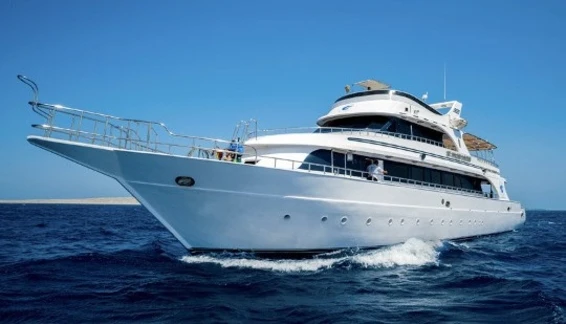
Dive experience: Required on Golden Dolphin I liveaboard safaris: Brothers, Daedalus Reef & Elphinstone/Red Sea South - Open water diver license and 50 logged dives (advanced diver license also recommended), North & Wrecks/St. John's - Open Water diver license and 30 logged dives.
Cruise price per person includes: Cabin accommodation with air-conditioning, breakfast, lunch, dinner (except on day of departure and arrival), snacks, water, soft drinks and hot drinks, return transfers from local airport/hotels to boat, port fees, dives (as detailed in the trips above), nitrox fills for certified enriched air divers, experienced English-speaking divemaster(s) (10 divers per DM), tanks, weights and weightbelts, 15 litre tank for return customers, sales tax.
Cruise price per person excludes (mandatory, unless customer provides own): Scuba equipment (USD 168 per week) (ordered in advance), dive computer (USD 39 per week), safari package (includes: Egypt entrance visa, meet and assist, fuel surcharge, harbour fees, permission fees, marine park fees and taxes) - 7 nights USD 392, SS Turkia trip surcharge USD 56. Unless otherwise stated, all the listed items need to be paid on arrival (cash only).
Optional extras: Alcoholic drinks, 15 litre tank (USD 39 per week), torch (USD 39 per week), dive insurance. Unless otherwise stated, all the listed items need to be paid on arrival. Note: prices of items purchased onboard are subject to change.
How to get there: M/Y Golden Dolphin I departs on its Red Sea liveaboard dive safaris primarily from Hurghada and Port Ghalib; return transfers are included from nearby hotels and from Hurghada and Marsa Alam airports to the departure port. Check-in time is 6 pm (boat departs next morning). Last check-out on the morning of the last day at 10 am (last night may be spent on board in the harbour or at a hotel depending on the itinerary). A day room can be arranged for early arrival or late departure (additional charge).
The last dive of the trip will be at around 12 noon on the second last day of the trip. Please wait at least 18 hours before flying after diving. For additional details, including airlines, see our Red Sea travel information section.
Non-diver rate: 25% off the published price.
Single supplement (if you do not want to share accommodation): This is optional - single travellers may choose to share a cabin and pay the regular rate, or pay a supplement of 50% for their own cabin.
Dive clubs and group discounts: USD 56 for groups of 8+ guests.
Whole boat charter rate (per night): Ask us for details.
Add-on package: If time permits, consider adding a land-based adventure to your Red Sea safari with Golden Dolphin I. We can craft a tour that includes the pyramids, the Sphinx, and the Cairo Museum, then continues south for a 4- or 5-night Nile cruise with stops at Edfu, Kom Ombo, and the Valley of the Kings. For a different perspective, we can arrange a 4x4 desert crossing from Cairo to Siwa, or a guided mountain trek in the Sinai. Camel tours, boat trips on the Nile, and visits to Nubian villages are also available. All packages are flexible in length and can be combined with hotel stays in Cairo, Luxor, or Aswan.
Brother Islands (8 Days / 7 Nights - 17 Dives)
Trip highlights: hammerhead sharks, shark action, manta rays, schooling fish & big pelagics
Diving environment: advanced divers, caverns, drift diving, healthy reefs, very popular, wall diving
Dive sites and activities: Big Brother, Little Brother, Aida II wreck, and Numidia wreck
Day 1
The adventure begins as you board the Golden Dolphin I at Port Ghalib or Hurghada. The tour leader and crew will welcome you on board, conduct a comprehensive safety and vessel briefing, and assign your cabin. Guests will arrive throughout the day. Dinner will be served before you retire for a good night's rest, with the promise of exceptional diving ahead.
Core Days
The Brother Islands rank among the world's finest dive destinations, and this itinerary is dedicated entirely to exploring them. The Golden Dolphin I liveaboard navigates to these 2 exposed promontories, rising from the deep approximately 60 kilometres off the Egyptian coast. Little Brother offers a remarkably high concentration of marine life in a compact area. Its walls are draped in sponges, anemones and an astonishing variety of hard and soft corals. The fish life is abundant, and shark encounters are routine: scalloped hammerheads, thresher sharks, grey reef sharks, silvertips and whitetip reef sharks are all frequently sighted. The site rewards patient divers who spend time in the blue, watching for these predators patrolling the drop-offs.
Big Brother, located about one kilometre north, features a lighthouse perched on its summit and a spectacular underwater topography of steep walls and deep drop-offs. The site is famous for two wrecks. The Numidia, a 150-metre steamer that sank in 1901, lies on the reef between 5 and 80 metres, now completely enveloped in hard and soft corals and gorgonians. The Aida, an 80-metre steam ship that sank in 1957, stands almost vertically on the sloping reef edge, with its highest point at 25 metres and propeller at 57 metres, offering a uniquely dramatic dive. Both wrecks are accessible when conditions allow, and their encrusted structures have become thriving artificial reefs.
The dives around the Brothers are not for the faint-hearted. Strong currents and exposed conditions demand respect and experience. The Golden Dolphin I is crewed by local experts who time each dive carefully, ensuring the best possible conditions for observing the big fish that congregate here at dawn and dusk. Thresher sharks, hammerheads, grey reef sharks, whitetips and blacktips all patrol these waters, alongside turtles, tunas and schools of mackerel. The sheer abundance of life, from the macro inhabitants of the coral-encrusted walls to the pelagic hunters in the blue, makes every dive an event.
A typical day aboard the Golden Dolphin I includes 3 dives, 2 in the morning and 1 in the afternoon , with a fourth dive offered when conditions and daylight permit. Night dives are not permitted within the Brother Islands marine park. On the penultimate day, 2 dives precede the return sail to port, allowing for a relaxed final evening on board.
Day 8
On the final morning, you can enjoy a hot farewell breakfast and a chance to say goodbye to your fellow guests and the crew. You will disembark the Golden Dolphin I and then be transferred to your hotel or the airport, carrying with you memories of some of the Red Sea's most iconic walls, wrecks and shark encounters.
Brothers & Safaga (8 Days / 7 Nights - 19 Dives)
Trip highlights: hammerhead sharks, shark action, manta rays, schooling fish & big pelagics
Diving environment: advanced divers, caverns, drift diving, healthy reefs, very popular, wall diving
Dive sites and activities: from Big Brother, Little Brother, Aida II wreck, Numidia wreck, Safaga: Shaab Sheer, Panorama Reef, Ras Abu Soma
Day 1
Join the Golden Dolphin I in Hurghada during the late afternoon. The crew will welcome you aboard, show you to your cabin, and conduct a full safety and orientation briefing. Dinner is served in the air-conditioned saloon, offering a chance to relax and get to know your fellow divers before the diving starts the following morning.
Core Days
This itinerary is built around 2 distinct regions: the offshore pelagic haven of the Brothers Islands and the varied reef systems of Safaga. It is a route that rewards experience, with deep walls, strong currents, and big fish action.
The first part of the cruise takes the Golden Dolphin I liveaboard to the Brothers Islands, roughly 60 kilometres from the Egyptian coast. Big Brother and Little Brother rise steeply from the deep, their walls layered with sponges, anemones, and hard and soft corals. Pelagic species are the main draw here: hammerheads, grey reef sharks, silvertips, and whitetip reef sharks are regularly seen. The wrecks add another dimension: the Numidia, a 150-metre cargo vessel that went down in 1901, is now thickly encrusted with corals, while the Aida, an 82-metre steamship, rests almost upright on the reef edge, her stern reaching 57 metres. The currents are strong and the depths are significant, so this part of the trip is suited to advanced divers.
The second half of the cruise moves to Safaga, where the character of the diving shifts. Shaab Sheer offers a shallow brain coral garden and a northern plateau where schools of tuna and barracuda are common, along with Picasso triggerfish and parrotfish. Panorama Reef has 2 distinct faces: a current-swept northern plateau with large table corals and clouds of anthias, and a more sheltered southern plateau where turtles and eagle rays are frequent sightings. Ras Abu Soma, a wall dive at the northern end of Safaga Bay, features a plateau at 25 metres and the possibility of encountering barracudas, mackerels, and occasionally grey reef or hammerhead sharks.
Day 8
After a light breakfast, it is time to say goodbye to the crew and disembark. Transfers are arranged to Hurghada Airport or your hotel.
Egypt Red Sea - Route Open
Trip highlights: hammerhead sharks, shark action, dolphins, manta rays, turtles, schooling fish & big pelagics
Diving environment: advanced divers, beginner divers, caverns, drift diving, healthy reefs, very popular, wall diving, wreck diving
Dive sites and activities: Route not yet decided. First booking of 2 customers will determine the route: Ras Mohamed & Tiran; North & Wrecks; Brothers; Brothers, Daedalus Reef & Elphinstone; or St. John's.
The Golden Dolphin I liveaboard offers seasoned divers the flexibility to set their course across the Red Sea’s most legendary waters, with the itinerary determined by the first 2 guests to book.
Should the choice fall on Ras Mohamed and Tiran, expect drift dives over pristine coral gardens and the chance to ride the currents past the famed Shark and Yolanda reefs, where the plateau drops away into the deep blue. For those drawn to history, the North & Wrecks route leads to the skeletal silhouette of the Dunraven and the submerged cargo of the Thistlegorm, her trucks and trains still resting in the gloom.
The Brothers islands deliver sheer walls adorned with soft corals, where grey reef sharks patrol the drop-offs, while combining Brothers with Daedalus and Elphinstone opens up encounters with oceanic whitetips and the graceful passage of scalloped hammerheads.
For a more southerly adventure, St. John’s rewards with less-visited reefs and intricate cave systems.
Whichever path the group chooses, the Golden Dolphin I liveaboard provides a stable base for accessing these world-class sites, with itineraries shaped entirely by the divers on board.
Fury Shoals & St. John's (8 Days / 7 Nights - 21 Dives)
Trip highlights: dolphins, manta rays, dugongs/manatees, turtles, schooling fish & big pelagics
Diving environment: advanced divers, caverns, drift diving, healthy reefs, very popular, wall diving
Dive sites and activities: St. John's reef system: Big Habili, Small Habili, Umm Erug, Umm Hararim, Paradise Reef, Dangerous Reef; Fury Shoals: Sataya, Shaab Maksour, Shaab Claudio, Abu Galawa Kebir, Abu Galawa Soraya; Shaab Sharm, Shaab Marsa Alam, Elphinstone
Day 1
Once onboard the Golden Dolphin I liveaboard in Port Ghalib, the crew and tour leader will welcome you, show you around the boat, assign your cabin, and provide a detailed briefing on the itinerary and other important information for your holiday. Enjoy dinner, before resting for the night; your diving begins the next day.
Core Days
This Golden Dolphin itinerary ventures into the deep south of the Red Sea, offering the opportunity to dive St. John’s Reefs, widely considered the most vibrant and healthy in the region. The underwater landscapes are spectacular, featuring dramatic drop-offs, pinnacles, canyons, caves, and tunnels decorated with stunning hard corals. Marine life is plentiful, with possible sightings of barracuda, various reef sharks, and occasionally dolphins, dugongs, and mantas. The liveaboard tour also incorporates a visit to Fury Shoals, a reef system renowned for its superb scuba diving and some of Egypt's most pristine reefs.
Big Habili, also known as Habili Ali, is a famous submerged reef in the St. John's system, and a highlight of the deep south. As a 'habili', its top sits several metres below the surface, and it plunges dramatically into the deep with steep walls. It is common to see barracuda, tuna, and jacks hunting in the blue. It is also a prime location for scuba divers to sight various sharks, particularly grey reef sharks, with hammerheads, silvertips, and oceanic whitetips also making appearances. The walls are covered in spectacular hard corals, alongside vast gorgonian sea fans and curtains of black coral.
Umm Erug, often known as Umm Arouk, is located in the heart of the St. John's reef system. Its name translates to 'the mother of coral towers'. The dive site is generally shallow with minimal currents, making it a relaxed and easy dive, as well as a popular choice for night diving. The coral-covered walls and pinnacles attract large shoals of reef fish, particularly sweetlips. It is also an excellent place to look for smaller creatures hidden in the recesses, such as octopuses, shrimps, and Spanish dancers.
Shaab Claudio is one of the most famous reefs in the Fury Shoals system. It is celebrated for its unique and accessible network of shallow caverns and swim-throughs. The reef itself is not just about the caves; the western side features a beautiful hard coral garden. Marine life is plentiful, and you can often find Napoleon wrasse, moray eels, and whitetip reef sharks. The coral blocks and ledges also provide a good habitat for macro life like nudibranchs.
The main attraction to liveaboard divers of Abu Galawa Soraya is the wreck of a small sailing yacht that sank in the 1980s. It rests upright on a sandy bottom at around 17 metres and is completely intact. The wreck is beautifully colonised by soft and hard corals and is often filled with dense shoals of glassfish. The reef itself is just as impressive. It features a magnificent, fairytale-like canyon or swim-through that cuts through the reef at a shallow depth. This leads out to a stunning hard coral garden on the reef's western side. The site is well-protected, with minimal current, making it perfect for underwater photographers and a popular choice for night dives.
There will only 2 dives on the last day before disembarkation as the Golden Dolphin I sails back to Port Ghalib.
Day 8
Following a small breakfast and saying farewell to the crew, check-out from the liveaboard in Port Ghalib. You will then be transferred to either the airport or your hotel.
Red Sea North & Wrecks (8 Days / 7 Nights - 21 Dives)
Trip highlights: dolphins, turtles, schooling fish & big pelagics
Diving environment: advanced divers, beginner divers, drift diving, very popular, wall diving, wreck diving
Dive sites and activities: Shaab El Erg, Bluff Point, Thistlegorm, Siyul Kebira, Siyul Soraya, Abu Nuhas wrecks (Giannis D, Carnatic, Kimon M, Chrisoula K), Shaab Umm Usk, Umm Gammar, Carless Reef
Day 1
Once onboard the Golden Dolphin I in Hurghada, you will be met by the crew and tour leader, who will show you around the boat, allocate your cabin, and explain the important details and itinerary for your liveaboard safari. Enjoy dinner in the air-conditioned saloon before retiring for the night; diving will commence the following day.
Core Days
The Golden Dolphin I liveaboard visits sites at the southern tip of the Sinai Peninsula. Ras Mohammed Marine Park provides superb diving, most notably at Shark and Yolanda Reef. These reefs boast a fantastic array of hard and soft corals, abundant fish life, and the chance to see sharks, particularly on morning dives. Arguably the most renowned wreck in the Red Sea, the SS Thistlegorm rests upright on the seabed at 32 metres. Its cargo includes tanks, lorries, motorbikes, weaponry, a railway carriage, and 2 railway locomotives. The Dunraven was a British cargo steamer that sank in 30 metres in 1876 after hitting a reef. The ship's hull is now inverted (upside-down), creating a massive, cavern-like structure that you can swim through and under. The signature highlight of the dive is the swim-through runs the entire length of the main cargo hold. You enter at the stern (the propeller is still visible here) and swim through a vast, dark chamber. Sunbeams pierce through portholes and holes in the hull, creating a cathedral-like, 'god-ray' effect that is incredibly dramatic and photogenic.
Diving at Abu Nuhas, the Red Sea's 'Ship Graveyard', offers a concentrated collection of world-class wrecks. This treacherous reef has claimed many vessels, with 4 forming the main attraction for divers. The Giannis D is a highlight of the liveaboard cruise; broken into 3 sections. It features an intact stern and a famous, easy swim-through in the engine room which is often full of glassfish. Its mast, located near the surface, is perfect for safety stops. The Carnatic, sunk in 1869, is the oldest and most picturesque. Its wooden decks have rotted away, leaving an iron skeleton resembling a whale's ribs, now covered in soft corals and home to groupers and sweepers. The Chrisoula K still has its cargo of Italian tiles visible, while the Kimon M rests deeper at 32 metres. These wrecks function as vibrant artificial reefs, attracting a huge amount of marine life. The metal structures are carpeted in colourful corals, hosting clouds of glassfish, as well as camouflaged lionfish and scorpionfish. Giant moray eels hide in crevices, while batfish and jacks patrol the blue.
There will be only 2 dives on the final day before disembarkation, as the Golden Dolphin sails back to Hurghada.
Day 8
Check-out is typically following a light breakfast and farewells with the crew, before your transfer to either Hurghada Airport or your local hotel.
Red Sea North, Safaga & Brothers (8 Days / 7 Nights - 19 Dives)
Trip highlights: hammerhead sharks, shark action, dolphins, manta rays, turtles, schooling fish & big pelagics
Diving environment: advanced divers, beginner divers, caverns, drift diving, healthy reefs, very popular, wall diving, wreck diving
Dive sites and activities: from Big Brother, Little Brother, Aida II wreck, Numidia wreck, Thistlegorm, Abu Nuhas wrecks (Giannis D, Carnatic, Kimon M, Chrisoula K), Dunraven, Rosalie Moeller, Ras Mohamed: Shark Reef and Yolanda Reef; Shaab-el-Erg, Small Giftun Island, Bluff Point, Siyul Kebira, Siyul Soraya, Shaab Um Usk, Shaab Um Gammar, Carless Reef, Salem Express, North Safaga: Shaab Sheer, Panorama Reef, Ras Abu Soma
Day 1
Board the Golden Dolphin I in Hurghada. The crew will greet you, direct you to your cabin, and deliver a thorough boat orientation covering safety procedures and the week ahead. Dinner is served in the air-conditioned saloon, giving you time to settle in and meet your fellow divers before the first dives begin the following morning.
Core Days
The Golden Dolphin I liveaboard combines the northern Red Sea's legendary wrecks with the offshore pelagic action of the Brothers Islands. The route begins with the classic wrecks of the north, including the SS Thistlegorm, resting upright in 30 metres with its famous cargo of wartime vehicles and motorcycles still visible in the holds. The Abu Nuhas reef system adds 4 more wrecks, each offering a different character and history. The Giannis D is often a highlight, its sections scattered across the reef, while the Carnatic, an 1860s steamship, is now thickly encrusted with table corals. Dunraven and Rosalie Moeller complete the wreck collection, with the latter requiring advanced certification due to its 50-metre depth.
Between the wrecks, the Golden Dolphin I visits the reefs of Ras Mohammed. Shark Reef and Yolanda Reef are the standouts, with walls dropping into clear water and schools of barracuda and trevally patrolling the blue. The current here brings in nutrients and pelagic life, making it a favourite for morning dives. Small Giftun Island offers a classic drift dive along a vertical wall draped in gorgonian corals, with Napoleon wrasse and turtles regular sightings. Shaab-el-Erg provides a more relaxed experience and the chance to encounter the resident pod of spinner dolphins. Bluff Point, Siyul Kebira, Shaab Um Gammar, and Carless Reef add further variety, with overhangs, crevices, and healthy coral growth.
The second half of the trip pushes south to the Brothers Islands, about 60 kilometres offshore. Big Brother and Little Brother are exposed promontories rising from deep water, their walls covered in sponges, anemones, and hard and soft corals. This is where the pelagic action happens: hammerhead sharks, grey reef sharks, silvertips, and whitetip reef sharks are frequent visitors. The Golden Dolphin I also dives the wrecks of the Numidia, a 150-metre cargo ship that sank in 1901 and is now encrusted with corals, and the Aida, a steam ship standing almost upright on the reef edge. The itinerary also includes Safaga sites such as Shaab Sheer, Panorama Reef, and Ras Abu Soma, where sloping reefs, brain coral gardens, and plateaus host eagle rays, turtles, and schools of tuna.
The trip typically runs with up to 4 dives per day, with only 2 dives on the final full day to allow a relaxed return to port.
Day 8
After a light breakfast, farewell the crew and disembark. Transfers are arranged to Hurghada Airport or your local hotel.
Red Sea North, Wrecks & Safaga (8 Days / 7 Nights - 21 Dives)
Trip highlights: dolphins, turtles, schooling fish & big pelagics
Diving environment: advanced divers, beginner divers, drift diving, very popular, wall diving, wreck diving
Dive sites and activities: Thistlegorm, Abu Nuhas wrecks (Giannis D, Carnatic, Chrisoula K), Ras Mohamed: Shark Reef and Yolanda Reef, Salem Express, North Safaga
Day 1
The tour leader and crew will welcome you on board of Golden Dolphin I in Hurghada. They will brief you about the liveaboard boat and the cruise, and assign your cabin. Guests will arrive throughout the day. Dinner will be served before bedding down for a good night’s sleep before the fun days ahead.
Core Days
The SS Thistlegorm, located in the Strait of Gubal in the northern Red Sea, is consistently ranked among the world's best wreck dives. This British armed Merchant Navy freighter was sunk by German bombers in October 1941, while en route to supply Allied forces. It is an extraordinary underwater museum, perfectly preserving its military cargo in the holds, including motorcycles, trucks, rifles, and 2 steam locomotives lying beside the hull. As a thriving artificial reef, the superstructure is covered in coral and attracts abundant marine life. Divers frequently encounter schools of batfish and snapper, along with cruising barracuda and trevally, moray eels, and occasionally a hawksbill turtle. Visibility is usually good, but moderate to strong currents are common, necessitating a descent line.
Abu Nuhas is a treacherous submerged reef in the northern Red Sea's shipping lane that has claimed at least 7 ships. 4 major wrecks are accessible to recreational divers of the Golden Dolphin I liveaboard. The oldest is the Carnatic, a British steamship sunk in 1869, now a stunning skeletal iron frame draped in soft corals at 24 metres. The Kimon M, a German cargo ship from 1978 carrying lentils, offers a deeper dive down to 32 metres. The Chrisoula K, a Greek freighter sunk in 1981, rests mostly upright with its cargo of Italian floor tiles visible, ranging from 3 to 26 metres. Finally, the Giannis D, a Greek timber carrier sunk in 1983, is broken into 2 sections and is popular for exploring its spacious engine room down to 28 metres.
Ras Mohammed is Egypt's first and most famous national park, situated at the southern tip of the Sinai Peninsula where the Gulf of Suez and the Gulf of Aqaba meet. It is widely considered one of the best diving destinations in Egypt owing to its rich biodiversity and dramatic underwater topography. The most renowned area is Shark and Yolanda reefs at the park's southernmost tip. This area features steep drop-offs plunging to over 800 metres and is famous for sightings of schooling fish and the occasional whitetip or grey reef shark. Yolanda Reef is unique for the scattered remains of the 1980 wreck of the Yolanda, whose cargo of bathroom fitting - toilets, baths, and sinks - is visible across the reef.
The main highlights of the Golden Dolphin I's visit to North Safaga include the Salem Express, Panorama Reef and Abu Kafan (meaning 'Father of the Abyss'). Panorama Reef is a colossal oval-shaped seamount, with sheer walls that plummet to hundreds of metres. It is famous for its stunning gorgonian fans, vast soft coral gardens, and the opportunity to spot oceanic visitors like reef sharks, tuna, and large napoleon wrasse, particularly off its northern and southern plateaus.
On the last day before disembarkation, there will only be 2 dives before the liveaboard sails back to port.
Day 8
After breakfast on the final day in Hurghada, you can check out, say your goodbyes to the liveaboard crew, and be transferred to the airport or hotel.
Red Sea North, Wrecks & Tiran Straits (8 Days / 7 Nights - 21 Dives)
Trip highlights: hammerhead sharks, turtles, schooling fish & big pelagics
Diving environment: advanced divers, beginner divers, drift diving, very popular, wall diving, wreck diving
Dive sites and activities: Thistlegorm, Abu Nuhas wrecks (Giannis D, Carnatic, Kimon M, Chrisoula K), Dunraven, Ras Mohamed: Shark Reef and Yolanda Reef; Straits of Tiran: Jackson, Woodhouse, Thomas and Gordon reefs
Day 1
Once onboard the Golden Dolphin I in Hurghada, you will be met by the crew and the liveaboard tour leader, who will show you around the boat, assign you a cabin, and explain the important information and the itinerary for your holiday in the North & Wrecks region and the Straits of Tiran. Enjoy your dinner in the air-conditioned saloon before going to bed. You will start diving the next day.
Core Days
The Golden Dolphin visits the sites at the southern tip of the Sinai Peninsula. The Ras Mohammed Marine Park provides superb diving, most notably at Shark and Yolanda Reef. These reefs boast a fantastic array of hard and soft corals, abundant fish life, and the chance to see sharks, particularly on the morning dives. Arguably the most renowned wreck in the Red Sea, the SS Thistlegorm rests upright on the seabed 32 metres down. Its cargo includes tanks, lorries, motorbikes, weaponry, a railway carriage, and 2 railway locomotives.
Diving at Abu Nuhas, the Red Sea's 'Ship Graveyard', offers a concentrated collection of world-class wrecks. This treacherous reef has claimed many vessels, with four being the main draw for divers. The Giannis D is a highlight of the liveaboard cruise, broken in 3 sections with an intact stern and a famous, easy swim-through in the engine room, often full of glassfish. Its mast, near the surface, is perfect for safety stops. The Carnatic, sunk in 1869, is the oldest and most picturesque. Its wooden decks have rotted, leaving an iron skeleton resembling a whale's ribs, now covered in soft corals and home to groupers and sweepers. The Chrisoula K still has its cargo of Italian tiles visible, while the Kimon M rests deeper at 32m. These wrecks function as vibrant artificial reefs, attracting a huge amount of marine life. The metal structures are carpeted in colourful corals, hosting clouds of glassfish, as well as camouflaged lionfish and scorpionfish. Giant moray eels hide in crevices, while batfish and jacks patrol the blue.
The Straits of Tiran, at the mouth of the Gulf of Aqaba, are a world-famous diving area defined by 4 major reef systems: Jackson, Woodhouse, Thomas, and Gordon. This narrow channel funnels strong, nutrient-rich currents, making for exhilarating drift dives along dramatic, coral-covered walls. These currents attract an incredible abundance of marine life, including vast schools of barracuda, jacks, and tuna. The area is particularly renowned for its pelagic encounters, offering one of the Red Sea's best chances to see various shark species, including whitetip reef sharks and scalloped hammerheads, especially at Jackson Reef.
The final day is limited to 2 dives, allowing time for the Golden Dolphin I liveaboard to sail back to harbour for disembarkation.
Day 8
Following a final breakfast and saying your farewells to the crew, you will be collected for your transfer to either Hurghada Airport or a local hotel.
Red Sea North, Wrecks, Tiran & Dahab (8 Days / 7 Nights - 20 Dives)
Trip highlights: turtles, schooling fish & big pelagics
Diving environment: advanced divers, beginner divers, drift diving, very popular, wall diving, wreck diving
Dive sites and activities: from Shaab El Erg, Gubal Island, Straits of Tiran, Gordon Reef, Jackson Reef, Thomas Reef, Ras Mohamed: Shark Reef and Yolanda Reef, Jackfish Alley, Dahab: Blue Hole, Dahab Canyon, Gabr El Bint, Thistlegorm, Kingston Wreck / Shag Rock, Abu Nuhas wreck: Giannis D, Siyul Kebir, Umm Gamar, Carless Reef
Day 1
Board the Golden Dolphin I in Hurghada during the late afternoon. The crew will welcome you, show you to your cabin, and deliver a detailed briefing covering safety, boat layout, and the days ahead. Dinner is served in the air-conditioned saloon, giving you time to relax and meet your fellow divers before the first dives begin the following morning.
Core Days
This cruise covers a remarkable amount of ground, linking the Sinai Peninsula's premier reef systems with the legendary wrecks of the northern Red Sea and the world-famous dive sites of Dahab. The Golden Dolphin I liveaboard moves through these regions with a schedule that balances deep wrecks, current-swept reefs, and sheltered lagoons.
The route begins with a visit to the Strait of Tiran, where 4 reefs - Jackson, Woodhouse, Thomas, and Gordon - rise from the depths at the entrance to the Gulf of Aqaba. These are classic drift dives, with walls covered in soft corals and gorgonians, and currents that attract large pelagics. Jackson Reef is a standout, with hammerhead sharks and eagle rays often sighted in the blue. Thomas Reef offers a spectacular canyon and some of the finest soft coral growth in the region. Gordon Reef, the southernmost of the strait, features a sandy amphitheatre known as the Shark Pool, where whitetip reef sharks and scalloped hammerheads are occasionally seen.
From Tiran, the Golden Dolphin I heads north along the Sinai coast to Dahab, where the diving takes on a different character. The Blue Hole is the most famous site, a 50-65 metre diameter sinkhole in the reef top, dropping vertically to depths of 70-110 metres. The Arch, a connection to the open sea at 55 metres, makes this a site for technical divers, but recreational diving along the outer wall is rewarding in its own right. The Canyon, a vertical fissure in the reef with depths from 25 to over 50 metres, is another advanced site, with swim-throughs and dramatic rock formations. Gabr el Bint, meaning 'The Grave of the Girl', offers 2 distinct dives: a steep, dark wall on the right side, and a healthier, more colourful left side with a forest of gorgonian fans and a sandy ledge home to turtles, stingrays, and snappers.
The return leg south brings the Golden Dolphin I back to the northern wrecks. The SS Thistlegorm, arguably the most famous wreck in the Red Sea, lies upright in 30 metres, her holds still packed with wartime vehicles, motorcycles, and railway wagons. The Kingston, at Shag Rock, is a shallower wreck with good swim-throughs. The Giannis D, one of the Abu Nuhas wrecks, lies broken across the reef and is a favourite for its photogenic sections and abundant marine life. Between the wreck dives, the trip includes Shaab el Erg, where spinner dolphins often rest, and Ras Mohammed, where Shark Reef and Yolanda Reef deliver exhilarating drift dives past walls of soft corals. Additional sites such as Siyul Kebir, Umm Gamar, and Carless Reef add variety, with overhangs, pinnacles, and giant moray eels.
Day 8
After a light breakfast, it is time to say farewell to the crew and disembark from the Golden Dolphin.
Red Sea South (15 Days / 14 Nights - 37 Dives)
Trip highlights: hammerhead sharks, shark action, dolphins, manta rays, turtles, schooling fish & big pelagics
Diving environment: advanced divers, caverns, drift diving, healthy reefs, very popular, wall diving
Dive sites and activities: Big Brother, Little Brother, Aida II wreck, Numidia wreck, Daedalus Reef, Zabargad, Rocky Island, Elphinstone, St. John's reef system: Big Habili, Small Habili, Umm Erug, Umm Hararim; Fury Shoals: Shaab Claudio, El Malahi, Abu Galawa Soraya; Shaab Sharm
Day 1
The liveaboard tour leader and crew will welcome you aboard Golden Dolphin I at Port Ghalib, brief you on the boat and the cruise, and assign your cabin. Guests will arrive across the day. Dinner will be served before heading off to bed for a good night's sleep before the scuba diving fun in the Southern Red Sea starts the next day.
Core Days
Among the best-loved liveaboard dive sites of the Red Sea are the famous Brothers Islands, two promontories that act as a magnet for marine life. Here, you will find walls covered in colour, including sponges, soft corals, and anemones. There is a very good chance you will spot a variety of sharks, including scalloped hammerheads, numerous grey reef sharks, silvertips, and whitetips.
Elphinstone is a world-renowned offshore reef near Marsa Alam, famous for its dramatic vertical walls and thrilling pelagic encounters. The walls are richly adorned with vibrant soft corals and gorgonian fans. The main draw is the potential to encounter large marine life, including shoals of pelagic fish, manta rays, and, crucially, various sharks. Oceanic whitetips (longimanus) are a major feature in autumn and winter, while scalloped hammerheads are often sighted around the northern plateau during the summer months.
Daedalus Reef is the Red Sea's largest offshore reef and marked by a distinctive Victorian lighthouse. The reef features sheer drop-offs and several plateaus offering a spectacular display of reef fish, including shoals of fusiliers, surgeonfish, and schooling trevallies. Daedalus is perhaps best known for its exceptional shark encounters; divers have a very high chance of sighting scalloped hammerheads, particularly at the northern tip, along with grey reef sharks, thresher sharks, and the impressive oceanic whitetips, which are present year-round.
One of the more current-swept areas of the Red Sea is Rocky Island. Here, the nutrient-rich water movement gives rise to healthy gorgonian fans, black coral trees, and sponges. Often found sheltering in the quieter spots are turtles, grey reef sharks, and silvertips. Manta rays and dolphins are also frequent visitors. Zabargad Island's topography includes spectacular walls, gentle drop-offs, and shallow coral gardens. Divers can explore a variety of habitats, including large pinnacles and seagrass beds, which are home to soldierfish, wrasses, and shoals of snappers. The island is also notable for the wreck of the Khanka, a Russian cargo ship lying in the shallower water near the south end, which is now heavily encrusted with corals.
The St. John's Reef system is often regarded as having some of the healthiest and most pristine coral formations in the entire Red Sea. Unlike the exposed offshore reefs, St. John's is a vast network of interconnected dive sites featuring large, horseshoe-shaped reefs, deep caverns, grottoes, and shallow, vibrant coral gardens. The topography is highly varied, offering everything from challenging walls to sheltered lagoon dives. The sheer diversity of the reef fish here is outstanding, including huge shoals of snappers, goatfish, and schools of bannerfish. Due to its remoteness, pelagic encounters remain excellent, with grey reef sharks and oceanic whitetips sometimes seen patrolling the deeper drop-offs, at sites like Habili Ali and Habili Gaffar.
On the last day before disembarkation, there will only be 2 dives before the Golden Dolphin I sails back to port.
Day 15
Following breakfast on the final morning, guests may check out from the liveaboard, say their farewells to the crew, and be transferred to the airport or their hotel in Port Ghalib.
Note: this itinerary can use the marina of Hurghada or Port Ghalib. Please check exact details for your trip.
[Information is best estimate in ideal circumstances and subject to changes beyond our control. The itinerary is a guide only and may be adapted to best suit the weather, tides, currents, availability and other prevailing events. Price is for the cruise, not for an exact number of dives].