Notes: Child policy: 25% discount from the safari rate for non-diving children and teenagers until 12 years old.
Dive experience: To join a Golden Imperial safari, the diver should have a minimum of 30 logged dives. For safaris in the southern marine parks, at least 50 logged dives must be demonstrated as per the regulation of the Egyptian Water Sports Authority: CDWS.
Cruise price per person includes: Cabin accommodation with air-conditioning, breakfast, lunch, dinner, snacks, water, soft drinks and hot drinks, return transfers from local airport/hotels to boat, dives (as detailed in the liveaboard trips above), 32% nitrox fills for certified enriched air divers, experienced English-speaking divemaster(s) (max. 10 divers per guide), 12 litre tanks, weights and weightbelts, sales tax.
Cruise price per person excludes (mandatory, unless customer provides own): Scuba equipment (USD 168 per week) (must be ordered 1 week in advance), diving computer (USD 39 per week), safari package (includes: Egypt entrance visa, meet and assist, fuel surcharge, harbour fees, permission fees, marine park fees and taxes: from USD 392), SS Turkia trip surcharge USD 56. Unless otherwise stated, all the listed items need to be paid on arrival (cash only - EGP, EUR, USD, CHF).
Optional extras: Alcoholic drinks, torch (USD 39 per week), 15 litre tank (USD 39 per week), dive insurance. Unless otherwise stated, all the listed items need to be paid on arrival. Note: prices of items purchased onboard are subject to change.
How to get there: The Golden Imperial departs primarily from Port Ghalib or Hurghada. Return transfers are provided from nearby hotels and from both airports to the departure point. Check-in is at 6 pm (the boat departs the following morning). Final check-out is at 10 am on the last day (the final night may be spent onboard in harbour or at a hotel, depending on the itinerary). The last dive takes place around 12 noon on the second-last day of the trip. Please allow at least 18 hours before flying after diving.
Transfers are arranged according to client arrival times, with no fixed operating schedule. Arrivals at any time, whether 10 am or late at night, will be met with a transfer to the boat. For flights arriving close together, a collective transfer is provided. For example, if some guests arrive at 3 pm and others at 4 pm, the first group is taken to the boat office to wait with tea, coffee, or a soft drink until the second group arrives. For very early arrivals, a room can be booked at the Bella Vista Hotel, including airport-to-hotel and hotel-to-boat transfers.
For more details, including airlines, see our travel information section for the Red Sea.
Non-diver rate: 25% off the published price.
Single supplement (if you do not want to share accommodation): This is optional - single travellers may choose to share a cabin or pay a supplement of 50% for sole occupancy.
Dive clubs and group discounts: USD 56 for groups of 8+ guests.
Whole boat charter rate (per night): USD 33 595 per week (28 guests).
Add-on package: Extend your Golden Imperial liveaboard adventure with a journey into Egypt's timeless landscapes. We can arrange a 5-night package that combines a 3-night Nile cruise from Luxor to Aswan with a 2-night desert expedition. On the river, you'll visit the Valley of the Kings, Karnak Temple, and the Philae Temple, with time to explore local markets and Nubian villages. In the desert, a 4x4 will take you into the White Desert for camping under the stars, with stops at the Crystal Mountain and the Black Desert. Camel rides and sandboarding are included. Departure dates are flexible, and the itinerary can be shortened or extended.
Brothers, Daedalus & Elphinstone (8 Days / 7 Nights - 17 Dives)
Trip highlights: hammerhead sharks, shark action, manta rays, schooling fish & big pelagics
Diving environment: advanced divers, caverns, drift diving, healthy reefs, very popular, wall diving
Dive sites and activities: Big Brother, Little Brother, Aida II wreck, Numidia wreck, Daedalus Reef and Elphinstone
Day 1
Your adventure begins at Port Ghalib. Once aboard the Golden Imperial liveaboard, the crew and tour leader will show you to your cabin, conduct a full safety briefing, and outline the itinerary. Enjoy your first dinner in the saloon as the boat prepares for an early departure to the offshore marine parks.
Core Days
This route is designed for experienced divers seeking encounters with the Red Sea's most iconic pelagic species. The Golden Imperial navigates to the Brother Islands, 2 remote pinnacles rising from deep water approximately 60 kilometres off the Egyptian coast. Big Brother and Little Brother offer spectacular wall diving, with drop-offs plunging to 500 metres. The walls are encrusted with sponges, anemones, gorgonian fans and a kaleidoscope of hard and soft corals. Early morning and dusk dives here are particularly rewarding, with scalloped hammerheads, grey reef sharks, silvertips and whitetip reef sharks regularly patrolling the blue. Thresher sharks are also frequent visitors. At Big Brother, the wreck of the Numidia , a 150-metre steamer sunk in 1901, rests between 5 and 80 metres, now completely enveloped in corals and gorgonians. The Aida, an 82-metre steamer that sank in 1957, stands almost vertically on the sloping reef edge, its highest point at 25 metres and propeller at 57 metres, offering a uniquely challenging dive.
Daedalus Reef, surrounded by steep walls and a southern plateau, is another highlight. The plateau drops from 30 to 40 metres and is covered in vibrant vegetation, with turtles and schooling fish frequenting the area. The northwest tip offers the best chance of encountering hammerhead sharks, while the west side features a remarkable anemone colony spanning 10 metres wide and 5 to 30 metres deep. Schools of fusiliers, surgeonfish and jacks are exceptionally dense here. Thresher sharks are also known to patrol the plateau.
Elphinstone Reef, a long finger-like rock formation running north to south, completes the trio. Its steep east and west walls drop into the depths, while the north and south ends feature submerged plateaus. Sharks are common visitors, drawn by the abundant reef fish population. Manta rays are also frequently sighted, particularly during the summer months.
A typical day aboard the Golden Imperial includes 3 dives, with night diving not permitted within the marine parks. On the final day, 2 dives precede the return sail to port, ensuring a full schedule of underwater exploration.
Day 8
After a final breakfast on board, you'll check out and bid farewell to the crew. Transfers will be arranged to the airport or your local hotel.
Please note that some trips may use Hurghada marina as the departure or arrival port; check your specific booking for details.
Egypt Red Sea - Route Open (8 Days / 7 Nights - 21 Dives)
Trip highlights: hammerhead sharks, shark action, dolphins, manta rays, turtles, schooling fish & big pelagics
Diving environment: advanced divers, beginner divers, caverns, drift diving, healthy reefs, very popular, wall diving, wreck diving
Dive sites and activities: Route not yet decided. First booking of 2 customers will determine the route: northern or southern regions of the Egypt Red Sea.
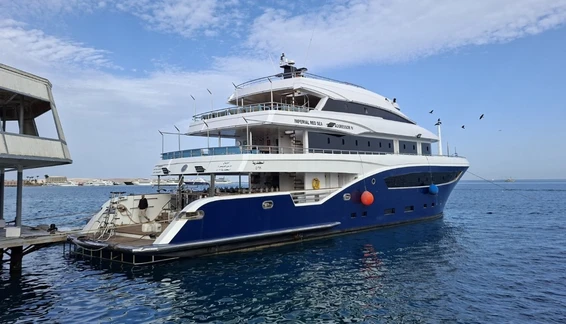
The Golden Imperial liveaboard offers an exceptional degree of flexibility, with its itinerary ultimately shaped by the first booking of 2 guests who will determine the route from a vast selection across the Egyptian Red Sea. This bespoke approach means your group could explore the legendary northern wrecks, including the iconic SS Thistlegorm and Rosalie Moller, or embark on the classic 'Best of the Red Sea' safari, which combines the pelagic-rich waters of the Brother Islands, Daedalus Reef, and Elphinstone with the remote, current-swept dive sites around Rocky Island and Zabargad. Alternatively, choose the untouched reefs of the Deep South around St. John's, or a specialised itinerary focusing on the vibrant marine life and drift dives of Fury Shoals and the Straits of Tiran.
With its modern design and a full range of routes available, the Golden Imperial is an ideal platform for crafting your perfect Red Sea expedition, whether you are seeking dramatic wall dives, wreck penetration, or encounters with pelagic species. This liveaboard, as part of the renowned Golden Dolphin fleet, is prepared to deliver a premium diving safari no matter which direction you choose.
Fury Shoals & Elphinstone (8 Days / 7 Nights - 21 Dives)
Trip highlights: hammerhead sharks, shark action, dolphins, manta rays, dugongs/manatees, turtles, schooling fish & big pelagics
Diving environment: advanced divers, caverns, drift diving, healthy reefs, very popular, wall diving
Dive sites and activities: Fury Shoals: Shaab Claudio, El Malahi, Abu Galawa Soraya, Abu Galawa Kebir, Shaab Maksur, Shaab Sataya (Dolphin Reef); Shaab Sharm, Elphinstone, Shaab Sharm, Shilineat
Day 1
Your southern Red Sea adventure begins at Port Ghalib, just a short 10-minute transfer from Marsa Alam Airport. The crew of the Golden Imperial liveaboard will welcome you on board, show you to your cabin, and provide a comprehensive safety and itinerary briefing. After settling in, enjoy your first dinner in the air-conditioned saloon as the boat prepares for an early start to the pristine reefs of the south.
Core Days
This expedition takes you deep into the Fury Shoals, a vast reef system celebrated for its untouched hard and soft corals, dramatic topography and abundant marine life. The Golden Imperial navigates through a landscape of plateaus, canyons, coral gardens and drop-offs. At Shaab Maksur, you'll explore its distinctive 3-tiered plateaus and a small lagoon sheltering wreckage now claimed by the reef. Abu Galawa Soraya offers the chance to dive a 15-metre yacht, sunk in 1980, now enveloped in corals and home to glassfish, needlefish, blue-spotted stingrays and free-swimming giant moray eels.
The nearby Sataya reefs, Gota Soraya and Gota Kebir, are famous for their resident pods of spinner dolphins. At Gota Kebir, night diving is particularly rewarding, with Spanish dancers, flatworms and shrimps emerging after dark. During the day, the area's caves, overhangs and coral gardens shelter snappers, bigeyes, barbels and reef sharks. The constant currents sweeping through the Fury Shoals bring pelagic visitors too; barracuda, giant trevallies and dogtooth tuna are common, and oceanic whitetip sharks occasionally cruise the deeper drop-offs.
Further north, Elphinstone Reef delivers some of the most exhilarating diving of the trip. Its steep, current-swept walls and exposed points make it a prime location for encounters with large pelagics, including oceanic whitetip sharks, mantas and thresher sharks. Dugongs and turtles are also regularly sighted in the shallower seagrass beds, while Napoleon wrasse patrol the reef edges. The Golden Imperial liveaboard provides access to these sites at optimal times, maximising your chances of memorable encounters.
A typical day aboard the Golden Imperial includes 3 to 4 dives, with a night dive offered when conditions permit. On the final day, 2 dives precede the return sail to port, ensuring a full and satisfying itinerary.
Day 8
After a final breakfast on board, you'll check out and bid farewell to the crew. Transfers will be arranged to the airport or your local hotel, bringing to a close a remarkable liveaboard safari through one of the Red Sea's most pristine and wildlife-rich regions with the Golden Imperial.
Fury Shoals & St. John's (8 Days / 7 Nights - 21 Dives)
Trip highlights: dolphins, manta rays, dugongs/manatees, turtles, schooling fish & big pelagics
Diving environment: advanced divers, caverns, drift diving, healthy reefs, very popular, wall diving
Dive sites and activities: St. John's reef system: Big Habili, Small Habili, Umm Arouk, Umm Hararim, Paradise Reef, Dangerous Reef; Fury Shoals: Sataya, Shaab Maksour, Shaab Claudio, Abu Galawa Kebir, Abu Galawa Soraya; Shaab Sharm, Shaab Marsa Alam, Elphinstone
Day 1
Once aboard the Golden Imperial in Port Ghalib, the crew and tour leader will welcome you, show you around the vessel, assign your cabin, and provide a detailed briefing on the itinerary and other important information for your holiday. Enjoy dinner in the saloon, then rest for the night. Your diving begins the next day.
Core Days
This itinerary takes the Golden Imperial liveaboard into Egypt's deep south, where St. John's Reefs sit far from the main dive traffic and have suffered far less pressure as a result. The coral here is dense, colourful and largely intact, and the topography is varied: sheer drop-offs, submerged pinnacles, canyons, caves and tunnels, all carrying a heavy covering of hard coral. Pelagic life passes through regularly, with barracuda and reef sharks common, and dolphins, dugongs and manta rays all possible depending on season and luck. The route also takes in Fury Shoals, a reef system that ranks among Egypt's most pristine.
Big Habili, also called Habili Ali, is a submerged reef whose top sits a few metres beneath the surface before plunging away on steep walls. It is one of the standouts of the deep south. Tuna, jacks and barracuda hunt in the blue off the reef edge, and grey reef sharks are regularly seen, with hammerheads, silvertips and oceanic whitetips also possible. The walls carry dense hard coral alongside large gorgonian fans and black coral. Small Habili offers a similar profile on a smaller scale, with sheltered sections that suit a slower, more detailed dive.
Umm Arouk, translates roughly as 'mother of coral towers', and the name fits. The site sits in the middle of the St. John's system and is generally shallow with little current, which makes it a relaxed dive and a good choice after dark. Coral-covered walls and pinnacles draw large shoals of reef fish, sweetlips in particular. It also rewards a close look into the recesses, where octopus, shrimp and Spanish dancers are often hiding.
Further south, Paradise Reef and Dangerous Reef add variety. Dangerous Reef, the southernmost of the St. John's group, hides a small cave system with an entrance at around 9 metres, easy to navigate and safe to explore. 2 ergs rise from 20 metres to just below the surface, and the surrounding coral gardens shelter giant morays and Napoleon wrasse. Currents here can be lively, which keeps the fish life active.
Shaab Claudio is one of the best-known sites in the Fury Shoals, largely because of its shallow cavern system. The swim-throughs are wide, well lit and straightforward, making them accessible to most divers. The western side of the reef opens into a hard coral garden. Napoleon wrasse, moray eels and whitetip reef sharks are common, and the ledges and coral blocks hold nudibranchs and other macro subjects.
At Abu Galawa Soraya, the main draw is a small sailing yacht that went down in the 1980s. It rests upright and intact on sand at roughly 17 metres, now heavily colonised by soft and hard corals, with dense shoals of glassfish inside. The surrounding reef is equally worthwhile, with a shallow canyon cutting through the structure that leads to a hard coral garden on the western side. Minimal current makes it a good site for photography and a reliable night dive. Shaab Marsa Alam and Elphinstone round out the itinerary, with Elphinstone offering steep walls and a reputation for oceanic whitetip encounters.
2 dives are scheduled on the final day before the Golden Imperial returns to Port Ghalib.
Day 8
Following a light breakfast and farewells to the crew, check-out takes place in Port Ghalib. You will then be transferred to either the airport or your hotel.
Red Sea North & Wrecks (8 Days / 7 Nights - 21 Dives)
Trip highlights: dolphins, turtles, schooling fish & big pelagics
Diving environment: advanced divers, beginner divers, drift diving, very popular, wall diving, wreck diving
Dive sites and activities: Shaab El Erg, Bluff Point, Thistlegorm, Siyul Kebira, Siyul Soraya, Abu Nuhas wrecks (Giannis D, Carnatic, Kimon M, Chrisoula K), Shaab Umm Usk, Umm Gammar, Carless Reef
Day 1
Once aboard the Golden Imperial in Hurghada, the crew and tour leader will welcome you, show you around the vessel, allocate your cabin, and run through the key details of the itinerary ahead. Dinner is served in the air-conditioned saloon, and the yacht remains moored overnight. Diving begins the following morning.
Core Days
This route is built around the shipwrecks that made the northern Red Sea famous, with reef dives threaded between them to break up the days. The Golden Imperial liveaboard works through this collection at a measured pace, giving each site the time it deserves.
The SS Thistlegorm remains the headline act. Sunk by German bombers in October 1941 while carrying supplies to Allied forces in North Africa, she sits upright on the seabed at around 32 metres. Her holds are still full: tanks, lorries, motorcycles, rifles, a railway carriage and two locomotives, all arranged much as they were when the ship went down. The wreck has become a busy artificial reef, with batfish and snappers hanging around the superstructure and tuna and barracuda cruising past on the outside.
At Abu Nuhas, 4 wrecks sit close together on the same reef, each offering a different kind of dive. The Giannis D is broken into 3 sections, and its intact stern and engine room allow straightforward swim-throughs, often packed with glassfish, with the mast rising close to the surface for safety stops. The Carnatic, lost in 1869, has rotted back to its iron frame, leaving rib-like arches that now carry soft corals and shelter groupers and sweepers. The Chrisoula K still holds its cargo of Italian floor tiles, resting shallow enough for a relaxed tour, while the Kimon M lies deeper at roughly 32 metres. Across all four, lionfish and scorpionfish blend into the encrusted metal, and giant morays peer out from the gaps.
Reef dives on the itinerary include Shaab El Erg, a horseshoe-shaped reef with a shallow lagoon and a northern tip popular for spotting dolphins. At Bluff Point, a drift along the coral wall on the north side of Little Gubal Island often brings encounters with Napoleon wrasse and turtles. Siyul Kebira and Siyul Soraya offer overhangs, crevices and dense coral growth, while Shaab Umm Usk is known for its resident bottlenose dolphins. Umm Gammar finishes with 3 coral towers, two hollow and packed with glassfish, the third opening into a sandy cave at 27 metres. Carless Reef is best known for its population of giant moray eels, which are unusually bold here.
2 dives are scheduled on the final day before the Golden Imperial returns to Hurghada.
Day 8
Check-out follows a light breakfast and farewells with the crew, before your transfer to Hurghada Airport or your local hotel.
Red Sea North, Safaga & Brothers (8 Days / 7 Nights - 21 Dives)
Trip highlights: hammerhead sharks, shark action, dolphins, manta rays, turtles, schooling fish & big pelagics
Diving environment: advanced divers, beginner divers, caverns, drift diving, healthy reefs, very popular, wall diving, wreck diving
Dive sites and activities: from Big Brother, Little Brother, Aida II wreck, Numidia wreck, Thistlegorm, Abu Nuhas wrecks (Giannis D, Carnatic, Kimon M, Chrisoula K), Dunraven, Rosalie Moeller, Ras Mohamed: Shark Reef and Yolanda Reef; Shaab-el-Erg, Small Giftun Island, Bluff Point, Siyul Kebira, Siyul Soraya, Shaab Um Usk, Shaab Um Gammar, Carless Reef, Salem Express, North Safaga: Shaab Sheer, Panorama Reef, Ras Abu Soma
Day 1
This scuba expedition begins as you board the Golden Imperial in Hurghada. The crew will greet you, direct you to your cabin, and deliver a thorough boat orientation covering safety procedures and the week ahead. Dinner is served in the air-conditioned saloon, giving you time to settle in and meet your fellow divers before the first dives begin the following morning.
Core Days
This comprehensive routeblends the northern Red Sea's legendary shipwrecks with the pelagic-rich waters of the Brother Islands, while also incorporating the fascinating wreck of the Salem Express and the diverse reefs around Safaga. The Golden Imperial liveaboard provides access to a remarkable variety of underwater environments across the voyage.
The trip opens with the classic northern wrecks. The SS Thistlegorm, resting upright at 30 metres, remains the region's most celebrated dive, her cargo of tanks, trucks, motorcycles, railway carriages and a locomotive offering an unparalleled glimpse into wartime history. Schools of barracuda, tunas and snappers now patrol this artificial reef. The Abu Nuhas reef system adds 4 wrecks, each with its own character: the Giannis D, with its sections scattered across the reef; the Carnatic, an 1860s steamship now thickly encrusted with table corals; the Chrisoula K, resting in an optimal position between 5 and 25 metres; and the Kimon M. The Dunraven, an inverted Victorian steamer, presents a cavern-like interior accessible through three main openings, while the Rosalie Moeller, resting at 50 metres, requires advanced certification.
Between the wrecks, the Golden Imperial visits the reefs of Ras Mohammed. Shark Reef and Yolanda Reef offer dramatic wall diving where schools of barracuda and trevally patrol the blue. The scattered remains of the Yolanda lie across a shallow plateau, now colonised by coral and reef fish. Small Giftun Island provides a classic drift dive along a vertical wall draped in gorgonian corals, with Napoleon wrasse and turtles regular sightings. Shaab-el-Erg offers a more relaxed experience and the chance to encounter a resident pod of spinner dolphins. Bluff Point, Siyul Kebira, Shaab Um Gammar and Carless Reef add further variety, with overhangs, crevices and healthy coral growth.
The expedition then pushes south to the Brother Islands, approximately 60 kilometres offshore. Big Brother and Little Brother are exposed promontories rising from deep water, their walls covered in sponges, anemones and hard and soft corals. This is where the pelagic action happens: scalloped hammerheads, thresher sharks, grey reef sharks, silvertips and whitetip reef sharks are frequent visitors. The wreck of the Numidia, a 150-metre cargo ship that sank in 1901, lies encrusted with corals and gorgonians, while the Aida, an 82-metre steam ship, stands almost vertically on the sloping reef edge, a uniquely dramatic dive.
The Golden Imperial itinerary also includes the Salem Express, a passenger ferry that sank in 1991 and now rests on her side in 30 metres, offering an emotive dive through the wreck's interior. Around Safaga, sites such as Shaab Sheer, Panorama Reef and Ras Abu Soma provide a change of pace. The brain coral gardens at Shaab Sheer host Picasso triggerfish, parrotfish and sling jaw wrasses, while Panorama Reef's plateaus feature large table corals, thousands of anthias and sightings of eagle rays, turtles and Napoleon wrasse. At Ras Abu Soma, grey reef sharks, whitetip reef sharks, leopard sharks and occasionally hammerheads are sighted in the blue, while the reef slope shelters moray eels, octopuses and cuttlefish.
Day 8
After a light breakfast and farewells to the crew, you will disembark the Golden Imperial and be transferred to Hurghada Airport or your local hotel.
Red Sea North, Tiran & Brothers (8 Days / 7 Nights - 19 Dives)
Trip highlights: hammerhead sharks, shark action, dolphins, manta rays, turtles, schooling fish & big pelagics
Diving environment: advanced divers, beginner divers, caverns, drift diving, healthy reefs, very popular, wall diving, wreck diving
Dive sites and activities: from Big Brother, Little Brother, Aida II wreck, Numidia wreck, Thistlegorm, Abu Nuhas wrecks (Giannis D, Carnatic, Kimon M, Chrisoula K), Dunraven, Rosalie Moeller, Ras Mohamed: Shark Reef and Yolanda Reef; Straits of Tiran, Shaab-el-Erg, Small Giftun Island, Bluff Point, Shaab Um Usk, Shaab Um Gammar, Carless Reef
Day 1
This northern Red Sea dive expedition commences as you join the Golden Imperial in Hurghada during the late afternoon. The crew will check you in, show you to your cabin, and run through a full safety and orientation briefing. Dinner is served in the air-conditioned saloon, giving you the chance to relax and get acquainted with your fellow travellers before the diving gets underway the next morning.
Core Days
The route packs an impressive variety into a single week, linking the celebrated wrecks of the northern Red Sea with the current-swept reefs of the Strait of Tiran and the offshore pelagic haven of the Brother Islands. The Golden Imperial opens with the region's most iconic wrecks, starting with the SS Thistlegorm. She rests upright at 30 metres, her holds still packed with wartime vehicles, motorcycles and railway wagons, a dive that ranks among the world's best. The Abu Nuhas reef adds more wrecks to the tally, each settled differently on the reef. The Giannis D, broken into sections, is particularly photogenic, while the Carnatic, an 1860s steamship, is now thickly coated in table corals. The Dunraven and Rosalie Moeller, the latter requiring advanced certification due to its 50-metre depth, round out the wreck collection.
The route also takes in the reefs of Ras Mohammed, where Shark Reef and Yolanda Reef deliver exhilarating drift dives past vertical walls covered in soft corals. Schools of barracuda and trevally patrol the blue, and the current often brings in pelagic action. Small Giftun Island offers a different experience: a drift along a wall draped in gorgonians, with Napoleon wrasse and turtles frequently seen. Shaab-el-Erg, a horseshoe-shaped reef, provides a more sheltered dive and the chance to spot the resident spinner dolphins. Bluff Point, Shaab Um Usk, Shaab Um Gammar and Carless Reef add further variety, with their overhangs, crevices and healthy coral growth.
The second half of the trip shifts to the Strait of Tiran, where 4 reefs mark the entrance to the Gulf of Aqaba. These are classic current-swept sites, with dramatic walls and plateaus covered in dense soft corals. Jackson Reef is the standout, with hammerhead sharks and eagle rays often seen in the blue, while Thomas Reef offers a spectacular canyon and some of the finest soft coral growth in the Sinai region. Gordon Reef's southern drop-off features the Sharkpool, a sandy depression where scalloped hammerheads and whitetip reef sharks gather.
The final leg takes the Golden Imperial to the Brother Islands, about 60 kilometres offshore. Big Brother and Little Brother are exposed islets rising from deep water, their walls blanketed in sponges, anemones, and hard and soft corals. This is where the pelagic action peaks: hammerheads, thresher sharks, grey reef sharks, silvertips and whitetip reef sharks are regular visitors. The wrecks of the Numidia, a 150-metre cargo ship that sank in 1901, and the Aida, a steam ship standing almost upright on the reef edge, add further interest.
A typical day aboard the Golden Imperial includes up to 4 dives, with only 2 on the final full day to allow a relaxed return to port.
Day 8
After a light breakfast, it is time to say goodbye to the crew and disembark the Golden Imperial. Transfers are available to Hurghada Airport or your hotel, bringing to a close a week that has encompassed wreck penetration, reef drift diving and encounters with some of the Red Sea's most spectacular pelagic life.
Red Sea North, Wrecks & Brothers (8 Days / 7 Nights - 19 Dives)
Trip highlights: hammerhead sharks, shark action, dolphins, manta rays, turtles, schooling fish & big pelagics
Diving environment: advanced divers, beginner divers, caverns, drift diving, healthy reefs, very popular, wall diving, wreck diving
Dive sites and activities: Big Brother, Little Brother, Aida II wreck, Numidia wreck, Thistlegorm, Abu Nuhas wrecks (Giannis D, Carnatic, Kimon M, Chrisoula K), Dunraven, Ras Mohamed: Shark Reef and Yolanda Reef. Cruises that use Port Ghalib may also dive at Elphinstone
Day 1
This Red Sea expedition begins as you board the Golden Imperial at Port Ghalib or Hurghada. The crew and tour leader will welcome you, show you to your cabin, and provide a detailed safety and itinerary briefing. Dinner is served in the air-conditioned saloon, allowing you to settle in before the diving commences the following morning.
Core Days
This itinerary delivers an attractive blend of northern Red Sea wreck diving and the pelagic-rich waters of the Brother Islands. The Golden Imperial liveaboard navigates from the historic shipwrecks of the north to the exposed promontories of the Brothers, where some of the region's most spectacular shark encounters await.
The trip opens with the northern wrecks. The SS Thistlegorm, resting upright at 32 metres, remains the Red Sea's most celebrated wreck, her holds containing wartime vehicles, motorcycles and locomotives that have become part of a vibrant artificial reef now patrolled by barracuda, trevally and snapper. The Abu Nuhas reef adds 4 more wrecks, each encrusted with corals and inhabited by glassfish, groupers, lionfish and moray eels. The Dunraven, an inverted Victorian steamer, presents a cavern-like interior accessible through 3 entry points, while the scattered remains of the Yolanda at Ras Mohammed's Shark Reef and Yolanda Reef lie colonised by coral and reef fish.
The second half of the trip pushes offshore to the Brother Islands, approximately 60 kilometres from the Egyptian coast. Big Brother and Little Brother are exposed promontories rising from deep water, their walls blanketed in sponges, anemones and hard and soft corals in an astonishing variety of colours. This is where the pelagic action peaks: scalloped hammerheads, thresher sharks, grey reef sharks, silvertips and whitetip reef sharks are regular visitors, particularly on early morning and dusk dives. The wreck of the Numidia, a 150-metre cargo ship that sank in 1901, lies on the reef between 5 and 80 metres, now completely covered with hard and soft corals and gorgonians. The Aida, an 82-metre steam ship that sank in 1957, stands almost vertically on the sloping reef edge, with its highest point at 25 metres and propeller at 57 metres, a uniquely dramatic dive.
Cruises departing from Port Ghalib may also include Elphinstone Reef, a finger-like formation with steep walls and submerged plateaus offering encounters with oceanic whitetip sharks, thresher sharks and manta rays during summer months.
A typical day aboard the Golden Imperial includes 3 dives, 2 in the morning and 1 in the afternoon, with a fourth dive offered when conditions permit. Night dives are not permitted within the Brother Islands marine park. On the final day, 2 dives precede the return sail to port.
Day 8
After a final breakfast on board the Golden Imperial, you will check out and bid farewell to the crew. Transfers will be arranged to Hurghada Airport or your local hotel.
Please note that this route may use Port Ghalib as the embarkation or disembarkation port; check exact details for your departure date.
Red Sea North, Wrecks, Tiran & Dahab (8 Days / 7 Nights - 20 Dives)
Trip highlights: turtles, schooling fish & big pelagics
Diving environment: advanced divers, beginner divers, drift diving, very popular, wall diving, wreck diving
Dive sites and activities: Shaab El Erg, Gubal Island, Straits of Tiran, Gordon Reef, Jackson Reef, Thomas Reef, Ras Mohamed: Shark Reef and Yolanda Reef, Jackfish Alley, Dahab: Blue Hole, Dahab Canyon, Dahab Habili, Thistlegorm, Kingston Wreck / Shag Rock, Abu Nuhas wreck: Giannis D, Siyul Kebir, Umm Gamar, El Mina Wreck
Day 1
Once onboard the Golden Imperial liveaboard in Hurghada, the crew and tour leader will show you to your cabin, conduct a comprehensive safety briefing, and outline the week's itinerary. Enjoy your first dinner in the air-conditioned saloon before retiring for the night, with diving set to commence at first light.
Core Days
This safari links the northern Red Sea's most revered dive sites, moving from historic shipwrecks to the drift dives of the Tiran Straits and the distinct underwater terrain around Dahab. The Golden Imperial sets course for Shaab El Erg, a reef shaped like a horseshoe whose northern tip and eastern wall provide consistent rewards. Gubal Island follows, with Bluff Point offering drift dives along the wall where Napoleon wrasse and hawksbill turtles are regular companions. At Umm Gammar, the eastern wall drops to 3 coral towers, 2 of which are hollow and packed with glassfish, while the third opens into a sandy cavern at 27 metres; all are blanketed in purple soft corals.
Wreck exploration is a defining element of the route. The SS Thistlegorm, sitting upright at 30 metres, remains the northern Red Sea's most famous wreck; her holds contain wartime vehicles, motorcycles and locomotives that have become part of an artificial reef now patrolled by barracuda, trevally and snapper. The Abu Nuhas reef system contributes 4 additional wrecks, each encrusted with corals and inhabited by glassfish, crocodile fish, scorpionfish and groupers. The inverted hull of the Dunraven, a Victorian steamer, forms a cavern-like structure with three entry points.
The Tiran Straits provide the expedition's most dynamic diving. Jackson Reef's triangular profile attracts hammerhead sharks near the Lara wreck, while its shallows host coral gardens, anemones, clownfish, eagle rays and Napoleon wrasse. Thomas Reef challenges experienced divers with vertical walls, gorges and a canyon featuring three rock bridges, where currents and downwellings demand careful attention. Gordon Reef's southern end holds the Sharkpool, a sandy depression where scalloped hammerheads and whitetip reef sharks congregate. Ras Mohamed National Park contributes wall dives at Shark Reef and Yolanda Reef, where the scattered contents of the Yolanda, including bathroom fixtures and a car, lie colonised by coral and reef fish.
The Golden Imperial liveaboard then proceeds north to Dahab. The Blue Hole, a sinkhole 50-65 metres across, drops vertically to 110 metres; its Arch connection to the open sea at 55 metres makes it a site for advanced divers only. The nearby Canyon descends from 25 to over 50 metres, with a narrow crack at 54-55 metres for technical exploration. Gabr el Bint offers a memorable night dive; its left side features dense gorgonian forests, while a sandy ledge supports coral heads alive with anthias, scorpionfish, parrotfish, triggerfish, stingrays and turtles.
Day 8
Following a final breakfast on board the Golden Imperial, you will check out and bid farewell to the crew, with transfers provided to Hurghada Airport or your local hotel.
St. John's & Abu Fendera (15 Days / 14 Nights - 39 Dives)
Trip highlights: dolphins, manta rays, turtles, schooling fish & big pelagics
Diving environment: advanced divers, caverns, drift diving, healthy reefs, very popular, wall diving
Dive sites and activities: Thistlegorm, Shaab El Erg, Bluff Point, Siyul Kebira, Siyul Soraya, Shaab Umm Usk, Umm Gammar, Carless Reef, Straits of Tiran: Jackson, Woodhouse, Thomas and Gordon reefs; Shaab Mahmoud, Dunraven, Ras Mohamed, Abu Nuhas: Carnatic, Chrisoula, Giannis; Salem Express, Big Brother, Little Brother, Aida II wreck, Numidia wreck, Daedalus Reef, Rocky Island, Zabargad
Day 1
Upon arrival at the Golden Imperial in Hurghada, the crew and tour leader will greet you, guide you to your cabin, and give you a tour of the vessel. A detailed briefing follows, covering the boat's routine and the two weeks ahead. Dinner is served in the air-conditioned saloon, and the yacht remains moored overnight. Diving begins on this 2-week Red Sea grand expedition the following morning.
Core Days
This fortnight-long safari amounts to a full tour of the Egyptian Red Sea. The Golden Imperial liveaboard works through four distinct regions in sequence, starting with the northern wrecks before heading offshore to the marine parks and then south to the remote reefs near the Sudanese border.
The northern leg opens with Shaab El Erg, a horseshoe-shaped reef with a shallow lagoon and a northern tip where dolphins are often seen. Bluff Point follows, a drift along the coral wall on the north side of Little Gubal Island, with Napoleon wrasse and turtles regularly in view. Siyul Kebira and Siyul Soraya provide overhangs, crevices and dense coral cover, while Shaab Umm Usk is known for its resident bottlenose dolphins. Umm Gammar finishes with three coral towers, two hollow and packed with glassfish, the third opening into a sandy cave at 27 metres. Carless Reef is best known for its unusually bold giant moray eels.
The wrecks at Abu Nuhas form a compact cluster on one reef: the Giannis D, broken into sections with an intact stern and an easy engine room swim-through; the Carnatic, lost in 1869 and now reduced to an iron framework draped in soft corals; the Chrisoula K, still carrying its cargo of Italian tiles; and the Kimon M, lying deeper at around 32 metres. All four have become thriving artificial reefs, with clouds of glassfish inside, lionfish and scorpionfish camouflaged against the metal, and batfish and jacks patrolling outside. The SS Thistlegorm needs little introduction - upright at 32 metres, her holds still packed with tanks, lorries, motorcycles, a railway carriage and 2 locomotives.
The Straits of Tiran deliver 4 reefs in close succession. Jackson Reef, triangular and current-swept, is the standout, with hammerheads often seen in the blue near the Lara wreck, plus eagle rays, Napoleon wrasse and dense coral gardens. Thomas Reef offers vertical walls, gorges and a canyon with three rock bridges, though its currents and downwellings suit experienced divers only. Woodhouse Reef is the longest of the four and is usually dived as a drift along its eastern side, with grey reef sharks and whitetips possible in the open water. Gordon Reef's southern plateau hides the Sharkpool, a sandy bowl where scalloped hammerheads and whitetip reef sharks are sometimes found resting. Ras Mohamed Marine Park follows, with Shark Reef and Yolanda Reef offering drift dives past vertical walls, schools of barracuda and jacks, and the scattered cargo of the Yolanda - toilets, bathtubs and all - now absorbed into the reef.
The offshore leg visits the Brother Islands, 2 exposed promontories roughly 60 kilometres from the coast. Big Brother and Little Brother carry walls thick with soft corals, sponges and anemones, and draw scalloped hammerheads, silvertips, whitetips and grey reef sharks. The Numidia, a 150-metre cargo ship that sank in 1901, lies on Big Brother's northern reef between 5 and 80 metres, now heavily colonised by gorgonians. The Aida, an 82-metre steamer lost in 1957, stands almost vertically on the reef edge, with its highest point at 25 metres and propeller at 57 metres. Daedalus Reef adds a steep-walled pinnacle with a southern plateau where turtles rest and thresher sharks occasionally pass. The northwest tip is the best bet for hammerheads, while the west side holds Anemone City, a colony of anemones spanning 10 metres wide across depths of 5 to 30 metres. Schools of fusiliers, surgeonfish and jacks gather here in numbers hard to match elsewhere.
The southern leg covers Rocky Island and Zabargad. Rocky Island is a demanding site, its fringing reef scoured by constant current. The south side has overhangs and half-caves where whitetip reef sharks rest, while the east and west points attract grey and silvertip reef sharks, plus tuna chasing sardine schools. The north wall, deeply indented with ledges, is where dolphins sometimes appear. Zabargad offers a gentler contrast, with shallow coral gardens, walls and drop-offs, and a lagoon ringed by passages cut through rock and covered in colourful soft corals. Wrasses, soldierfish and large schools of snappers populate the reef. A Russian freighter of uncertain origin lies on the east side between 1 and 24 metres, and on the west side, at 24 metres, divers can find the scattered remains of the safari boat Neptuna - a generator, suitcases, a radar unit and a diving tank - though the hull itself has never been located.
The Salem Express provides the final wreck of the trip. The ferry ran aground on Shaab Sheer reef in December 1991 while returning from Jeddah and sank within minutes. She now lies on her starboard side between 11 and 32 metres. The wreck has been declared a grave, and while the stern door has been opened, the cabins remain off-limits. Dives are conducted on the exterior only.
Day 15
Check-out follows a light breakfast and farewells to the crew, before transfer to Port Ghalib Airport or your local hotel.
Note that this route sometimes runs in reverse, so check your trip details for the specific direction of travel.
[Information is best estimate in ideal circumstances and subject to changes beyond our control. The itinerary is a guide only and may be adapted to best suit the weather, tides, currents, availability and other prevailing events. Price is for the cruise, not for an exact number of dives].
The morning starts early on the Golden Imperial liveaboard, with coffee and tea available in the saloon from first light. Breakfast is served buffet-style in the lower deck dining area, offering a selection of hot dishes, breads, cereals, and fresh fruit. Dive briefings follow, and the first jump into the water usually happens by 8 am.
Between dives, the saloon becomes the social hub of the Golden Imperial. This is where soft drinks, water, tea, and coffee remain available throughout the day at no extra charge, and where snacks like cookies, crisps, and fresh fruit are put out to keep energy levels up. On some afternoons, a savoury treat like pizza might appear. For those wanting something stronger, beer and wine are available after diving at an additional cost.
Lunch and dinner are served buffet-style in the dining area, with a spread that might include meat, poultry, fish, pasta, rice, potatoes, and vegetables. The kitchen team can accommodate vegetarian, vegan, and other dietary needs, provided they are notified in advance. Meals are occasionally served on the outside deck when conditions allow, offering a pleasant change of scenery.
The daily dive schedule on the Golden Imperial typically includes 3 to 4 dives during the sea days, with routes adapting to weather, conditions, and the group's skill level. On the last full day, 2 dives are scheduled before the boat returns to the marina. The on-board language is English, and the crew is always on hand to assist with equipment or answer questions.
When not diving, guests can relax in the spacious saloon with its comfortable sofas and media system, or head up to the sun deck and fly deck for some fresh air. Wifi is provided free of charge, though coverage depends on proximity to the mainland. Smoking is not permitted in cabins, the saloon, or on the dive deck, especially when dry suits are hanging or oxygen is in use.
Evenings are spent unwinding, reviewing the day's highlights, and preparing for the next. The Golden Imperial liveaboard is designed for divers who appreciate a balanced routine, good food, and ample time to recharge between dives. Special dietary requests, drink preferences, and any other needs are best communicated to our office before the trip, so the crew can make sure everything is ready from the moment you step on board.