Notes: Child Policy: Minors under 18 must be accompanied by and share a cabin with a parent/guardian. Children occupy a full bed space onboard and are charged at the full adult rate. Children under 10 years old are generally not recommended.
Dive experience: Recommendation for all Grand Discovery trips: advanced open water diver license and a minimum of 10 logged dives. Open water divers can join the trips if they complete the advanced course during the trip. Note: divers may be requested to sit out a dive if the guides assess that it is beyond their experience level.
Cruise price per person includes: Cabin accommodation with air-conditioning, breakfast, lunch, dinner, snacks, soft drinks, drinking water, hot drinks (e.g. instant coffee, tea), round-trip transfers from/to Hurghada and Marsa Alam airports, dives (as detailed in the trips above), 32% nitrox fills for enriched air certified divers, 3 experienced CWDS English-speaking divemasters, 12 litre tanks, weights/weightbelt, sales tax.
Cruise price per person excludes (mandatory, unless customer provides own): Scuba equipment (incl. dive computer, SMB: USD 263 per week), diving insurance, port/park/environmental fees (from USD 80 per week). Fuel surcharge (USD 80 per week). Unless otherwise stated, all the listed items need to be paid on arrival (cash - EUR, USD, GBP, EGP, or bank card (+2%)).
Optional extras: Alcoholic drinks, torch (USD 46 per week), 15 litre tank (USD 40 per week). Unless otherwise stated, all the listed items need to be paid on arrival. Note: prices of items purchased onboard are subject to change.
How to get there: Grand Discovery liveaboard trips operate from 2 departure points: Hurghada New Marina and Port Ghalib. Airport transfers are included from both Hurghada and Marsa Alam airports. Guests travelling between Hurghada and Port Ghalib should allow approximately 4 hours for the journey. Check-in opens at 4 pm on day 1. The vessel remains in port overnight and sets sail the following morning. For those arriving on later flights, boarding is still possible until 8 am on day 2. For further planning advice, including airlines, visit our Red Sea travel information section.
The final dive of the trip takes place at 10 am on the penultimate day, with the yacht returning to port at approximately 2:30 pm. Disembarkation is at 10 am on the final morning. A minimum surface interval of 18 hours is required before any flight.
Non-diver rate: 10% discount (cannot be combined with other discounts).
Single supplement (if you do not want to share accommodation): This is optional - solo travellers may choose to share a cabin and pay the regular price, or pay a supplement of 50% for their own private-use cabin.
Dive clubs and group discounts: Pay for 10 guests and 1 additional person can join the cruise free of charge. Pay for 16 guests and 2 additional guests can join free of charge.
Whole boat charter rate (per night): Pay for 32 guests and 4 extra guests can join free of charge. Total cost is route dependent; ask us for details.
Add-on package: For clients booking a Grand Discovery liveaboard trip, we suggest considering an extension to include some of Egypt's remarkable cultural attractions. The Egyptian Museum in Cairo, with its collection of pharaohs and royal mummies, the Pyramids of Giza, and the Great Sphinx are all within reach. A Nile cruise down to the Valley of the Kings offers another perspective on the country's ancient heritage. These world-famous sites can be added to your itinerary to create a more complete Egyptian experience. For further details, explore our dedicated page on antiquities tours in Egypt.
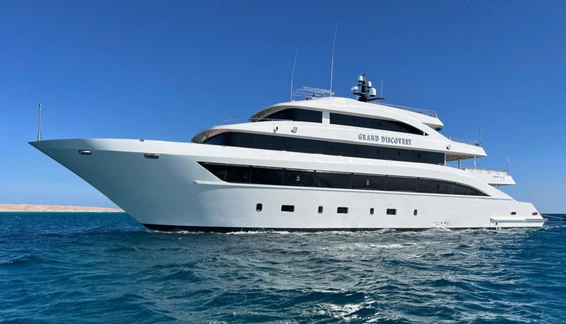
The Red Sea remains one of the world's most reliable destinations for liveaboard diving, offering clear water, diverse marine life, and a range of itineraries that suit both newer divers and seasoned travellers. The Grand Discovery liveaboard enters this market as a vessel designed specifically around the needs of scuba divers. It was built with diving infrastructure as a priority. This focus on function shapes everything from the dive deck layout to the storage facilities and tank capacity.
At 45 metres in length, the steel-hulled Grand Discovery accommodates up to 36 divers across its cabins. The vessel carries 52 aluminium tanks in both 12-litre and 15-litre sizes, supported by 2 Bauer compressors running at 450 litres per minute and a dedicated nitrox membrane system producing up to 1,000 litres per minute. For certified divers, nitrox up to 32% is included in the cruise price, a significant benefit for those planning multiple dives across a week-long itinerary.
The dive deck is equipped with individual stations, and the vessel carries 3 zodiacs, including 2 large 6.5-metre RIBs with 115 HP engines. This allows groups to be split efficiently and access sites that larger tenders cannot reach. The Grand Discovery also features the ENOS GPS-based diver rescue and location system, an added layer of safety that tracks divers at the surface and assists with recovery if needed.
Above the waterline, the Grand Discovery offers comfortable spaces to relax between dives. There are 2 shaded sundecks, one of which includes a bar, and a skydeck with a Jacuzzi. These areas provide a contrast to the focused atmosphere of the dive deck, giving guests room to spread out, read, or socialise. The saloon and dining areas are air-conditioned, and meals are served buffet-style with a mix of local and international dishes.
Trips with the Grand Discovery cover the full range of Red Sea diving. Northern routes take in the wrecks of Ras Mohamed and Tiran, including the SS Thistlegorm. Southern routes reach the marine parks of Brothers, Daedalus, and Elphinstone, where pelagic encounters are more likely. Some trips combine both regions, offering a broader overview. The vessel operates from Hurghada and Port Ghalib, with transfers provided from Hurghada and Marsa Alam airports.
The operator behind the Grand Discovery liveaboard has years of experience running Red Sea diving safaris and maintains a fleet of vessels designed for scuba diving. For divers seeking a straightforward, well-equipped liveaboard with solid infrastructure and access to the Red Sea's best sites, the Grand Discovery is a practical choice.
The Grand Discovery liveaboard has 18 guest cabins with en-suite bathrooms. There are 6 twin bed cabins on the lower deck and 6 on the upper deck. There are also 2 panoramic master suites with large double beds on the upper deck. On the top deck there are 4 more master suites with large double beds.
All the cabins have:
- Air-conditioning
- En-suite bathroom with hot-water shower and hand basin
- Portholes on lower deck, windows on upper deck
- Towels & bathrobes
- Reading lights
- Bedside cabinet
- Fridge (upper deck cabins only)
- Cabinet, mirror and shelves
- Bedding
- 24-hour, 220v electricity supply
- European-style 2-pin plugs
- Fire alarm, life jackets and fire extinguishers
No. of bathrooms / showers - 13 / 11 - hot water
Brothers, Daedalus & Elphinstone (8 Days / 7 Nights - 17 Dives)
Trip highlights: hammerhead sharks, shark action, manta rays, schooling fish & big pelagics
Diving environment: advanced divers, caverns, drift diving, healthy reefs, very popular, wall diving
Dive sites and activities: Hurghada, Big Brother, Little Brother, Aida II wreck, Numidia wreck, Daedalus Reef, Elphinstone, Safaga, Salem Express
Day 1
Your Red Sea diving expedition begins at the designated marina, either Hurghada or Port Ghalib depending on your departure. You will be welcomed aboard the Grand Discovery liveaboard by the crew, receive a full vessel orientation, and settle into your cabin. Dinner in the saloon is a relaxed opportunity to meet your fellow certified divers before the vessel begins its overnight crossing to the offshore reefs.
Core Days
This week is dedicated to 3 of the Red Sea's most exposed marine parks: the Brother Islands, Daedalus Reef and Elphinstone. All 3 rise from deep water far from the coast, and all three are known for the same thing - current-swept walls that concentrate pelagic life. The Grand Discovery is a stable platform for the crossings and full diving days this route requires, and the crew time each entry to make the most of conditions.
The Brother Islands are 2 promontories rising from considerable depth and form part of the Marine Park Islands National Park. Big Brother and Little Brother carry dense marine growth along their walls: soft corals, gorgonians, sponges and hard corals, all packed tightly together. That growth supports a high volume of predators. Grey reef sharks are particularly common on Little Brother's plateaus, alongside silvertips and whitetips. Scalloped hammerheads, silky sharks, oceanic whitetips and thresher sharks also appear depending on the season and conditions. Tuna, barracuda, jacks and snappers work the open water off the walls. Big Brother holds 2 wrecks worth diving. The Numidia, a cargo ship lost in the early 20th century, sits at a depth that suits most certified divers and is now thickly covered in hard and soft corals and gorgonians. The Aida II, a steamer that went down in 1957, stands almost vertically on the reef edge, its stern section well within reach and its structure heavily colonised by coral.
Daedalus is a remote standalone reef roughly 400 metres by 100 metres. It is marked by a 30-metre lighthouse built in 1863 and rebuilt in 1931, still active with a flashing pattern every 30 seconds, and the site is accessible only by boat. The reef features deep walls and pristine coral formations. Currents here are strong, and that is precisely what brings in the fish. Daedalus is one of the most reliable sites in Egypt for hammerhead sharks, with grey reef sharks also frequently seen. The southern plateau offers a break from the current, with reef fish crowding the shallows and turtles resting on the coral.
Elphinstone, also known as Sha'ab Abu Hamra, is an isolated reef about 30 kilometres north of Marsa Alam. Its long, finger-like profile runs north to south, with steep walls on both sides and submerged plateaus at either end. Soft corals, particularly dendronephthya species, dominate the landscape, and the site is known for grey reef sharks patrolling the plateaus. Oceanic whitetip sharks can be spotted in the area through most of the year, and green sea turtles and Napoleon wrasse are common along the reef.
The Grand Discovery trip is balanced with a visit to the wreck of the Salem Express near Safaga. This 100-metre ferry sank in 1991 and now rests on its starboard side between 11 and 32 metres. It has been declared a grave, so dives are conducted on the exterior only. The structure is colonised by marine life and provides refuge for blue-spotted stingrays and schools of butterflyfish. Panorama Reef and Ras Abu Soma are also included, offering wall dives, coral gardens and the chance of pelagics in the blue.
Day 8
The Grand Discovery returns to the pre-agreed port, either Hurghada or Port Ghalib. Following a farewell breakfast, you will check out and disembark.
[Information is best estimate in ideal circumstances and subject to changes beyond our control. The itinerary is a guide only and may be adapted to best suit the weather, tides, currents, availability and other prevailing events. Price is for the cruise, not for an exact number of dives].
A day on board the Grand Discovery liveaboard starts with a first dive at 7 am, when the light is still soft and the reef is just stirring. By the time you surface, breakfast is waiting in the air-conditioned saloon: a buffet spread that typically includes eggs cooked to order, pancakes, toast, fresh bread, a selection of fresh fruit and vegetables, cereals with milk or yoghurt, plus cheese and sausages.
There is always hot coffee and tea on hand. By 10 am, the crew has your next tank ready, and you are back in the water for the second dive. Lunch follows at noon, served buffet-style with dishes that lean on local ingredients: fresh vegetables, rice or noodles, and a choice of chicken, beef, or fish.
The third dive of the day starts around 2 pm, and by mid-afternoon the chef puts out snacks: fresh fruit, cookies, and juice for a quiet moment on the shaded upper deck. If conditions allow, a night dive happens at 7 pm, an optional but often unforgettable way to see the reef after dark. Dinner is served around 8 pm, and the meals here are generous without being fussy. On a recent trip, one evening brought a spiced chicken tagine, another a simple grilled catch of the day with roasted vegetables and a crisp salad. Between all of this, the Grand Discovery offers self-service tea, coffee, soft drinks, and drinking water around the clock, with a selection of fine wines and beer available for those who want something more.
Vegetarian and vegan diets are well accommodated, and the crew handles most other dietary needs with advance notice. The experience on the Grand Discovery is one of immersion: you wake, dive, eat, rest, and repeat, with the daily routine designed to let you focus on the diving while the boat and crew take care of everything else.